Here is a test for your monetization stack.
A request arrives for a premium article. Can any single system in your stack tell you who it is, what they are entitled to, and enforce that answer before the content goes out the door?
For most publishers the honest answer is no.
They run seven or more products that each handle a piece of the problem, none of them talks cleanly to the others, and the one question that matters falls down the gaps between them.
The stack is crowded - what is missing is a single place that owns the whole question.
This is a map problem. The category lines that used to organize this stack have moved, and most teams are still buying against the old ones.
What moved
Three shifts have redrawn the map in the last two years.
Payments absorbed the logic. Billing platforms used to move money while a separate layer handled the business rules. That line collapsed. Stripe and its peers now handle tax, retries and even feature provisioning natively, so a lot of the middle layer publishers used to buy no longer earns its place.
Identity gave way to entitlements. Logging a reader in became a commodity.
The hard, valuable question moved from “who are you?” to “what are you allowed to do?” - which is a different system entirely.
Bot management stopped being only security. Now that bots make up more than half of web traffic - they overtook humans for the first time in 2024, by Imperva’s count - treating all of it as a threat to block leaves money and control on the table. The job shifted from mitigation to governance.
Each shift left a gap the old categories don’t name. Put them together and you get a cleaner map.
The new map
A modern monetization stack has four jobs, and they are clearest when you stop pretending one tool does all of them.
Payments and billing - what was charged. Move the money, handle tax and dunning, record the transaction. Stripe, Paddle and the billing platforms own this, and they own it well.
Metering - what was consumed. For usage and consumption models (tokens, calls, compute), a metering engine counts billable events in real time. If your unit of value is a seat, you can skip this. If it is a token, you cannot.
Identity - who is at the door. Verify the credential. Solved, cheap, fast.
Access and entitlements -what each visitor is allowed to do. The decision, made per request, for humans and machines alike, and enforced before content is served. This is the layer the old map never had a box for, and it is where the question at the top of this piece gets answered.
Why the gap sits at access
Notice that three of the four layers are mature. Payments are excellent. Metering is well served for the companies that need it. Identity is a commodity.
The unstaffed layer is access - the one that has to absorb everything the other three shifts created. Here the subscriber, the lapsed reader, the anonymous visitor, the AI agent and the crawler each get a different answer, decided per request and enforced at the edge, before the page loads, so it cannot be walked around.
Access is the only layer that treats humans and machines as what they now are: different requests carrying different entitlements.
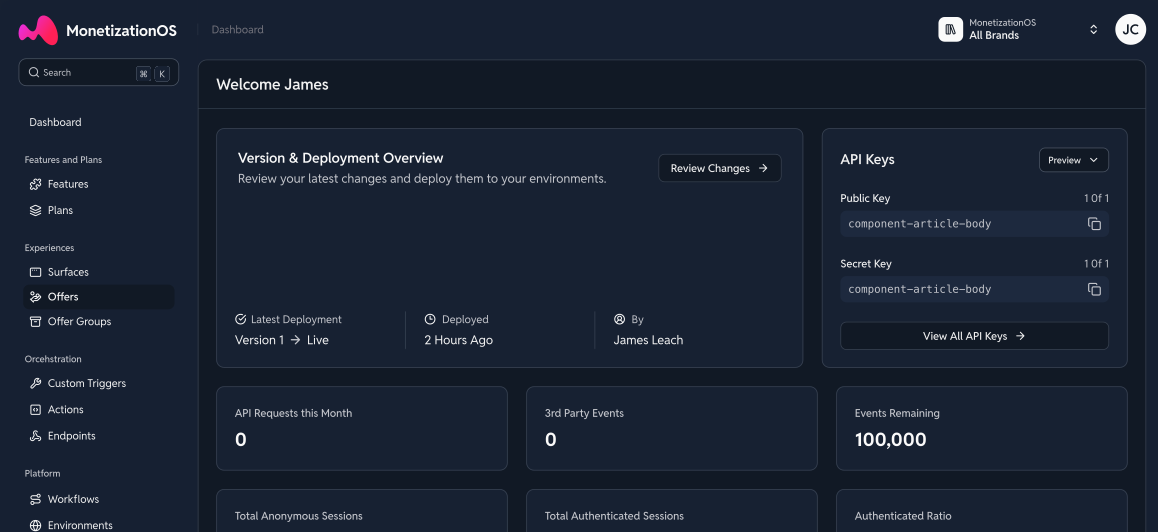
This is what MonetizationOS provides: the decision layer that sits above your payments platform and governs what every visitor gets.
If your stack cannot answer the visitor question in one place, you do not need a seventh tool bolted alongside the other six. You need the layer the map was missing.
Which of the four layers is the one your stack can’t answer for? That’s usually where the revenue is leaking out.