
TL;DR
- The binary paywall question (show the page or charge for it) was built for an era when every visitor was a human reading on a desktop, and it cannot express the commercial relationships publishers now need to manage across humans, AI agents, training crawlers, search indexers and machine-to-machine calls.
- Visitor identity is a commercial decision, not a security one. A first-time reader from search, a returning subscriber, a lapsed account and an AI agent acting on a subscriber's behalf are four distinct entitlement decisions that should be configured by the business and enforced on every request, not collapsed into one rule.
- Lifetime value is the right unit of analysis, not conversion rate. Wharton's Peter Fader has put it cleanly: decisions about acquisition, retention and development should not be driven by cost considerations but by future value. Most access systems are optimised for the wrong number.
- Article-level dynamic offers are the publishing equivalent of airline yield management. Robert Crandall's pricing revolution at American Airlines after 1978 deregulation generated an extra five hundred million dollars a year and spread to hotels, car rentals and every industry with perishable inventory and segmented demand. Publishing has been one of the last to make the transition.
- Machine traffic is a commercial relationship, not a security event, and the playbook already exists. Stripe and Twilio built multi-billion dollar businesses on per-transaction pricing, the API economy now generates revenue for sixty-five percent of organisations, and the ASCAP/BMI infrastructure built to license music to radio in 1914 still governs rights across television, streaming and retail today. Publishing is at the 1914 moment for AI consumption of original content, and what gets built now defines the commercial framework for the next century.
Much of the publishing industry is optimising around one question: should this person see this page? Here are five better questions.
For two decades, the access decision in publishing has been a binary one. Show the page or charge for it. Let the visitor in or send them to a subscription form. The infrastructure publishers built was built to answer that single question, and it answered it well enough when the only visitors were human readers browsing a website on a desktop.
That world has gone. The visitors arriving at publisher infrastructure today include first-time human readers, returning subscribers, lapsed accounts, AI agents acting on behalf of subscribers, training crawlers, search indexers, aggregators and machine-to-machine API calls that did not exist five years ago, and each one represents a different commercial relationship that the binary access question cannot express.
Here are five better questions the access decision should be answering.
1. Who is this visitor, and what is the right relationship?
A first-time reader from search is not the same visitor as a returning reader who arrives three times a week, who is not the same as a lapsed subscriber whose card last failed in March, who is not the same as an AI agent acting on behalf of an active subscriber. These are four distinct commercial relationships, and each one calls for a different offer, a different price, and in some cases, different content entirely. The publishers building durable subscription businesses have stopped treating every visitor as the same access question and started treating each visitor as a distinct entitlement decision, made on every request, against rules the business has set in advance. That granularity is the defining work, and a single binary applied uniformly to every visitor on every page cannot do it.
2. What are they worth over time, not just today?
Conversion rate tells you whether someone clicked subscribe. It tells you nothing about what happens after. A subscriber acquired through a heavy introductory discount who churns at month three is worth materially less than a reader who registers for free, builds a habit over six months, and converts at full price when the relationship is mature enough to support it. It is easy to grow subscription numbers if you give the product away cheaply, but the revenue line does not lie, and Wharton's Peter Fader has put the underlying principle as cleanly as anyone: “decisions about customer acquisition, retention and development should not be driven by cost considerations but by future value”. Most access systems are configured to maximise the count of people who hit subscribe today rather than what those subscribers are worth across the full life of the relationship, and the second question requires an access layer that can see a visitor's full journey, model their likely value and adapt the offer to fit, not a paywall that has a fixed view of the world and applies it identically to every reader who passes through it.
3. What is the right offer at this moment?
A hard meter after three articles is one answer to the question of when to ask for payment, but it is the same answer for every visitor in every context, applied identically to a news story, a feature, a recipe and an investigative piece.
The structural parallel here is airline yield management. Until 1978, US airfares were regulated and every seat on every flight was priced uniformly, until deregulation forced the industry to compete and Robert Crandall, then president of American Airlines, coined the term yield management and built the first system to vary fares dynamically by demand, timing, route and customer segment. American claimed an extra five hundred million dollars a year from the practice, profits grew forty percent over the following years, and Crandall later called yield management the single most important technical development in transportation management since deregulation. The technique spread directly to hotels after Crandall shared it with Bill Marriott, and from there to car rentals, cruise lines and most other industries with perishable inventory and segmented demand, leaving uniform pricing behind in each one. Publishing has been one of the last large content industries still running on the uniform model.
The article-level decision is the better one for content: which pieces are worth gating harder because their value to paying readers justifies it, which should stay open to drive reach and acquisition, and which deserve to be the lead conversion asset this week. Expressing that variation in real time requires an entitlements layer that can take rules from the business and enforce them on every request, not a paywall hardcoded by engineering and only changed when the next release ships, and the difference between the two is the difference between an access system that responds to commercial reality and one that constrains it.
4. Should this visitor see a price, or something else first?
Not every access decision is about payment. Sometimes the right ask is a registration. Sometimes a newsletter signup. Sometimes the right answer is to let the visitor read and earn the right to ask later, when the relationship has developed enough that a paid offer will land rather than bounce. The tension between maximising subscription conversions and preserving ad inventory is real, and resolving it requires showing different visitors different things in different sequences, treating registration, paid subscription and free access as distinct commercial outcomes the access system can produce for the right visitor in the right context, rather than a single binary applied uniformly to everyone walking through the door.
5. Should a machine pay to access this page, and how?
This is the newest question and the one almost nobody has an answer to yet. Roughly half of the traffic arriving at publisher infrastructure today is not human, and almost none of it is paying, while the prevailing responses have been to block crawlers as a security threat or ignore them entirely, neither of which treats machine traffic as the commercial relationship it has actually become. The Associated Press, Axel Springer, the Financial Times, the Washington Post, Condé Nast, Schibsted and News Corp have all signed licensing deals with AI companies in the past two years, and those deals are early proof that AI companies will pay for access to original content when the relationship is structured commercially, but those first-generation arrangements were necessarily coarse because the publisher infrastructure on the other side could not express the conditional, metered, time-limited, use-case-separated terms that a properly licensed relationship needs.
Two parallels are worth holding onto here. The first is contemporary: machine-to-machine commerce is one of the most mature parts of the software industry. Stripe built one of the most valuable private companies in technology by charging a percentage on each transaction it processes, Twilio built a multi-billion dollar business pricing communications at fractions of a cent per message, and Postman's 2025 State of the API report found that sixty-five percent of organisations now drive revenue through APIs, with nearly one in four deriving more than half their total revenue from API programmes. The infrastructure to meter, price and bill machine access has been refined across fifteen years and processes trillions of transactions a year, which means publishers pricing machine access today are not pioneering a new commercial model but adopting one the technology industry has already validated at enormous scale.
The historical parallel is older. Songwriters formed ASCAP in 1914 to handle public performance royalties, and broadcasters founded BMI in 1939 to strengthen their bargaining power against ASCAP, with the consent decrees that followed in 1941 establishing the rate-court structure that still governs music licensing today. ASCAP and BMI now control more than ninety percent of the US performance rights market, and the infrastructure they built in the early twentieth century to license music to radio stations has been adapted across the following hundred years to license the same rights to television, streaming services, restaurants, retail establishments, gyms, hotels and concert venues. Publishing is at the 1914 moment for AI consumption of original content, and what gets built now will define the commercial framework for the next century of machine consumption.
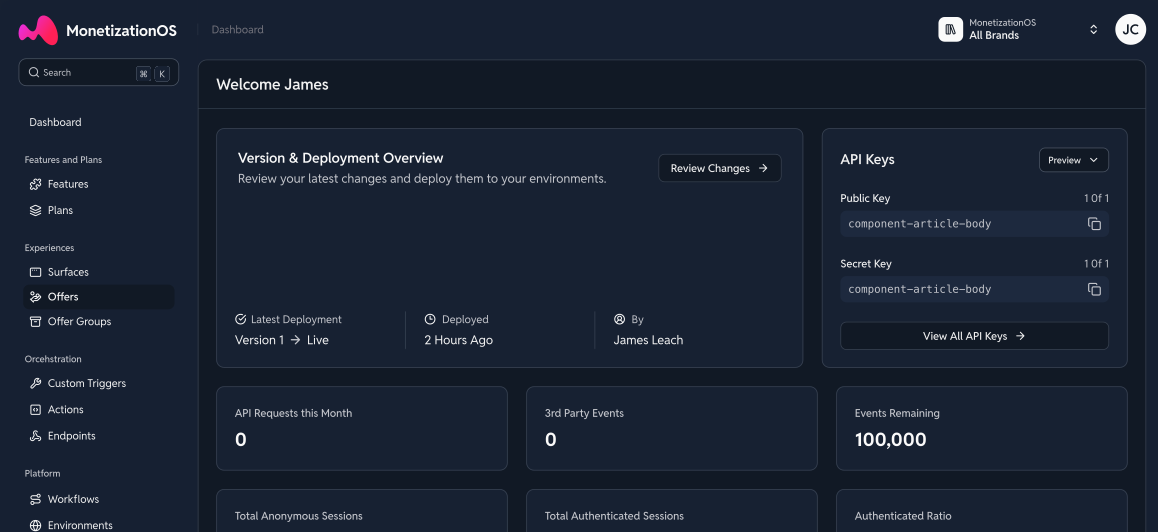
We built MonetizationOS to treat machine access as a commercial relationship rather than a security event, because a training crawler, a real-time inference system and an AI agent acting on a subscriber's behalf are three different commercial relationships, each with their own entitlements, usage rules and pricing logic. None of that is expressible by access infrastructure designed for human readers making a binary subscribe-or-leave choice. It requires an access layer that can govern, licence and charge for every visitor, human or machine, through a single system.
The common thread
Each of the five questions points the same way. The access decision is no longer one decision but a system of decisions that varies by visitor, by moment, by content, by the value of the relationship and increasingly by whether the visitor is even human, and a single binary applied identically to every request cannot answer five questions with five different rules in real time. Every other major service industry has run this transition already: airlines and hotels with yield management, software with freemium and usage-based pricing, music with collective licensing infrastructure that now spans a century of consumption models.
The publishers getting this right are not doing it because they have better content or larger audiences but because they have stopped treating access as a gate and started treating it as the strategic commercial layer it has become, the layer where every visitor relationship is governed, every piece of content is monetised, and every commercial decision is made and enforced in milliseconds at the edge.
That is what strategic sovereignty over your content actually means in practice, and it begins with an access stack that can answer all five questions, not just the first one.
--------------
MonetizationOS is edge-native infrastructure that governs and monetises every access request in real time, from human audiences to AI agents. One million free operations per month, no setup fees, deploys in hours. Get started at monetizationos.com.