A competitor launches a bundle on Tuesday. By Friday, your growth team has a response they want to test. It ships six weeks later.
Six weeks is the problem.
The competitor’s offer has been live the entire time, the market has moved on, and the test you finally run is answering a question that has already changed.
At most publishers, six weeks is normal speed for a pricing change - and normal is far too slow for a market that now moves in weeks.
The reason is structural.
A single pricing change has to pass through the billing system, the paywall, the CMS and the analytics tool, and each one needs an engineer to touch it. So a change you could describe in a sentence turns into a project across four systems.
The problem is where your logic lives
This is monetization debt: business logic scattered across tools that were never built to let the business change it. Engineers would file it under technical debt, but the people it actually slows down are the commercial teams who can’t ship without a ticket.
Pricing logic is the clearest case.
In most stacks it is hard-coded into the billing system, which means a marketer cannot test a new offer without an engineer rebuilding part of the plumbing. Access rules live somewhere else again — in the CMS, the paywall, a few cron jobs — so changing who sees what means touching several systems at once.
Every experiment becomes an integration project, and integration projects get scheduled, not run.
The speed mismatch this creates compounds: the slower you are to test, the less you learn, and the further behind the market you fall.
A three-lens audit
You can find your worst offenders in an afternoon. Take every tool in the monetization stack and put it through three lenses.
Revenue enablement. Can the business run a pricing or access experiment on this tool without an engineering ticket? Can it segment visitors and target offers? If launching a test means a code change, that is a flag.
Maintenance burden. How many hours a month does your team spend keeping this tool running — fixing integrations, reconciling data, working around limits — rather than using it? If maintenance time beats improvement time, the tool is costing more than it returns.
Replacement cost. What would it actually take to remove this and consolidate the job elsewhere? Include the experiments you cannot run today. Sometimes the “expensive” switch is cheaper than another year of working around the limits.
Then ask the one question that sorts the list: if we turned this tool off tomorrow, would our experiments move faster or slower?
Anything that would make you faster is a candidate to cut.
Where the speed comes back
The pattern under almost every slow stack is the same: pricing logic trapped inside billing, and access rules trapped inside code.
Pull those two decisions out into a layer the business can change directly — where pricing is decoupled from the billing engine, and access rules are configured rather than deployed — and the quarter-long test becomes a same-week one.
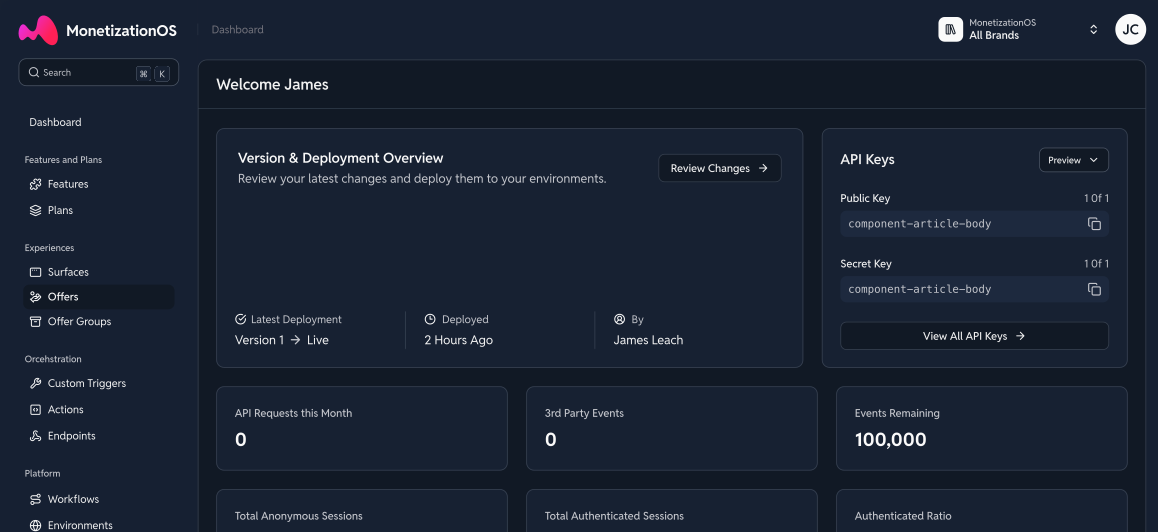
That is the role an access and entitlement layer plays. It separates what you decide (who gets what, at what price, on what terms) from the systems that merely execute it, so a change to the decision does not require a change to the plumbing. MonetizationOS is that layer, and it is the difference between a stack that lets you keep pace with the market and one that quietly sets your speed limit.
The market is not going to slow down to match your release cycle.
The only variable you control is how fast your stack lets you answer it.