
TL;DR
- Entitlements are the atomic units of monetization - they define what each user can actually do with your product, not what they paid
- They bridge commercial and technical decisions - translating pricing, packaging, and promotions into access rights without touching application code
- Critical for both human and machine traffic - as AI agents become major consumers of content, entitlements enforce who can access what, at what price, at machine speed
- The foundation for intelligent monetization - clean entitlement infrastructure unlocks A/B testing, personalization, dynamic retention, and agent-negotiated access
<div anchor>Introduction</div>
Entitlements, the unsung heroes
When businesses talk about monetization, the conversation normally starts with pricing and packaging. What should we charge? Which plans should we offer? What should they include?
These are important questions, for sure, but they are not necessarily the right place to start.The real foundation for a successful monetization strategy is something far less glamorous and far more powerful - entitlements. Entitlements are the atomic units that determine what each user can actually do with your product. Not what they paid, but what access, features, and capabilities they have in the product at any given moment, regardless of whether they are an anonymous, registered, or premium user.
“Pricing is what you charge. Entitlements are what you deliver”
Entitlements are the primitives of successful monetization, yet most companies still treat them somewhat as an afterthought. We believe entitlements deserve their time in the sun as first-class infrastructure - especially now, as the line between human and machine consumption of digital content and products rapidly blurs.
<div anchor>What are entitlements, really?</div>
What are entitlements, really?
At their simplest, entitlements are the permissions that define what a user can do within your product. A subscriber entitled to "premium articles" can read them. A user entitled to "HD streaming" can stream in high definition. A user on an "ad-lite" plan sees fewer ads than free users. A user with 50 messages for the AI chat can use those before being blocked.
So far, so good.
But this basic definition undersells the importance of entitlements. They are the bridge between what you offer, who you offer it to, and how your product behaves. They translate commercial decisions into technical realities inside your application.
This bridging function is what makes them so powerful and so often misunderstood. When entitlements are implemented well, commercial teams can change pricing, packaging, and promotions without touching application code. When they are implemented poorly, every pricing or plan change becomes an engineering project.
In practice, entitlement decisions reduce to primitives like:
- A boolean aka, an on-or-off decision. You can download offline content, or you can't.
- A string controls configuration by name. Your video quality is "HD" or "4K".
- A number sets a parameter like 14 days of data retention or a rate limit of 1,000 requests.
- And metered access tracks consumption against a resetting allowance - this can be anything from 10 free articles per month, to 500 API calls per day or 100 AI chat messages.
What makes this powerful is that a single feature can carry multiple properties at once. Take a feature like "Articles". It might have a metered property governing how many articles a user can read per month, a boolean for whether premium longform is included, and a string defining the content quality tier.

Each of these properties can then be set differently across plans - an anonymous human reader from Reddit gets 5 metered articles with no premium access, a paid subscriber gets unlimited reads at the highest tier, and an authenticated AI agent might get metered access with a per-request limit and a content-quality flag that governs what articles can be used for inference. Maybe you licensed some content from Reuters, and that can’t be accessed at all.
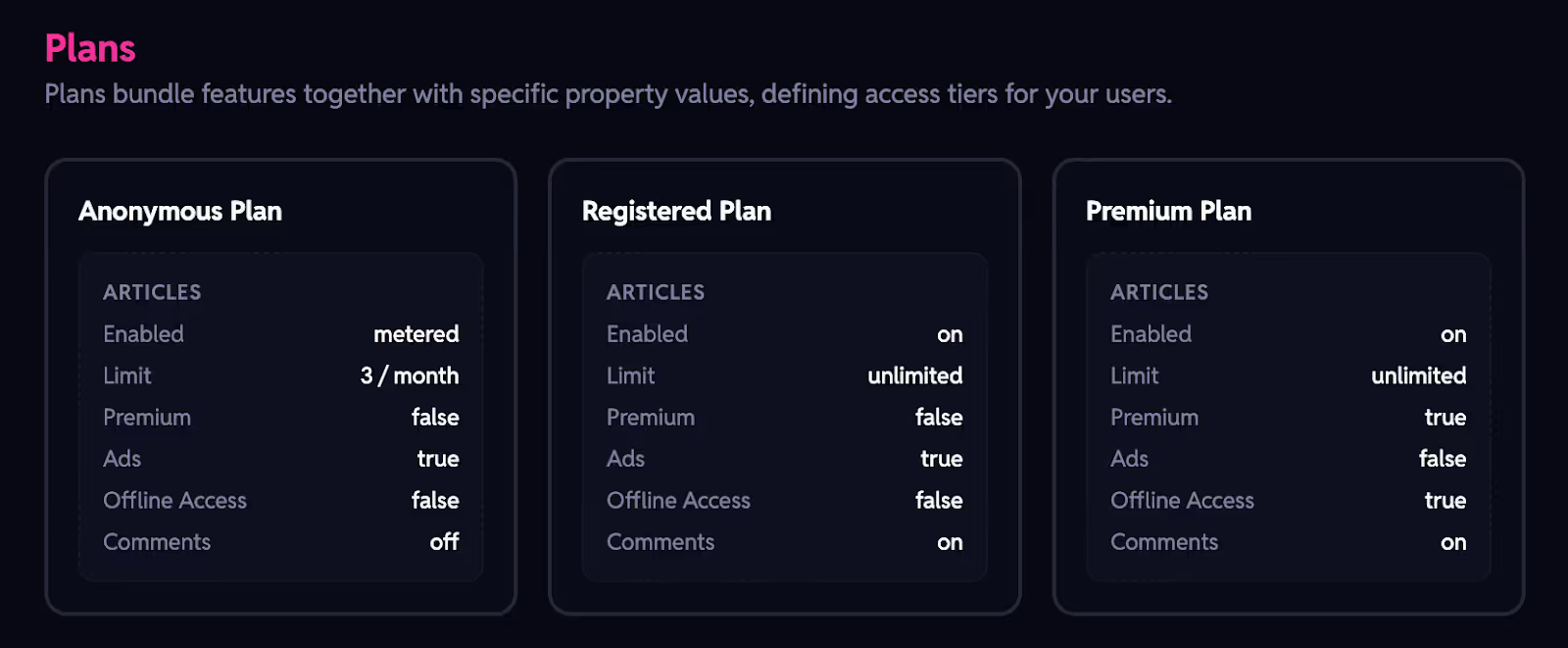
The feature stays the same. The properties are the dials. Plans set the dial positions for each audience and user. Most businesses need all three working together, across many consumer touchpoints, talking to other systems, in order to make an intelligent access and monetization decision. Maybe you have segmentation or lead scoring, or an AI model for conversion or retention optimization. That is where the real fun (and complexity) begins.
When you want to change pricing or packaging, what you are really doing is changing which entitlements attach to which products. The application code doesn't change. It only knows about features and entitlements, not prices. When you ship a new feature, you add it to the catalogue and decide which entitlements grant access. The billing system doesn't change.
<div anchor>Why this matters even more for B2C</div>
Why this matters even more for B2C
The importance of well-architected entitlements is amplified in consumer-facing businesses dealing with web scale and intellectual property.
Anonymous users.
Much of your audience hasn't logged in, let alone subscribed. And they come to your front door from many different sources. You need cheap entitlement decisions for users who don't exist in your billing system - and a way to encourage their usage, and retain their usage history, when they register or purchase later on. Otherwise you can’t see what worked, train models and improve outcomes in the future.
High scale, low latency.
Consumer traffic comes in bursts. Entitlement checks happen on what we call the hot path - the critical moment before content is served. If your access check, modal or paywall adds +250 milliseconds to every page load, you're losing users before they even see your content.
Complex content rules.
This article is free, that one is premium. This video is available in Europe, but not Asia. This partner content can't be scraped. That podcast is free for a week, then goes behind the paywall. You need one place to define the guardrails of your business.
Metered access.
The classic media model - free articles per month - is fundamentally an entitlement problem that is exploding in the AI era. But what about new paradigms like how often a user can access content via an AI agent? Track consumption, enforce limits, reset counters, handle cleared cookies and multiple devices. Errors here directly impact revenue.
<div anchor>The new consumers</div>
The new consumers
When someone asks their AI assistant, or agent, it synthesises an answer from multiple sources. Even Google itself is rapidly becoming an answer engine. Some predictions say that non-human traffic will be over 90% by 2030, and web visitors are declining as a result.
Infrastructure is already emerging to try to tackle this momentous challenge and build the rails of the agent economy. The Really Simple Licensing standard (RSL) provides machine-readable rights declarations. The x402 protocol, backed by Coinbase, Stripe, and Cloudflare, revives the long-dormant HTTP 402 "Payment Required" status code for machine-to-machine micropayments. Markdown responses and MCP-style structured endpoints are enabling authenticated, programmable and optimized access for AI agents.
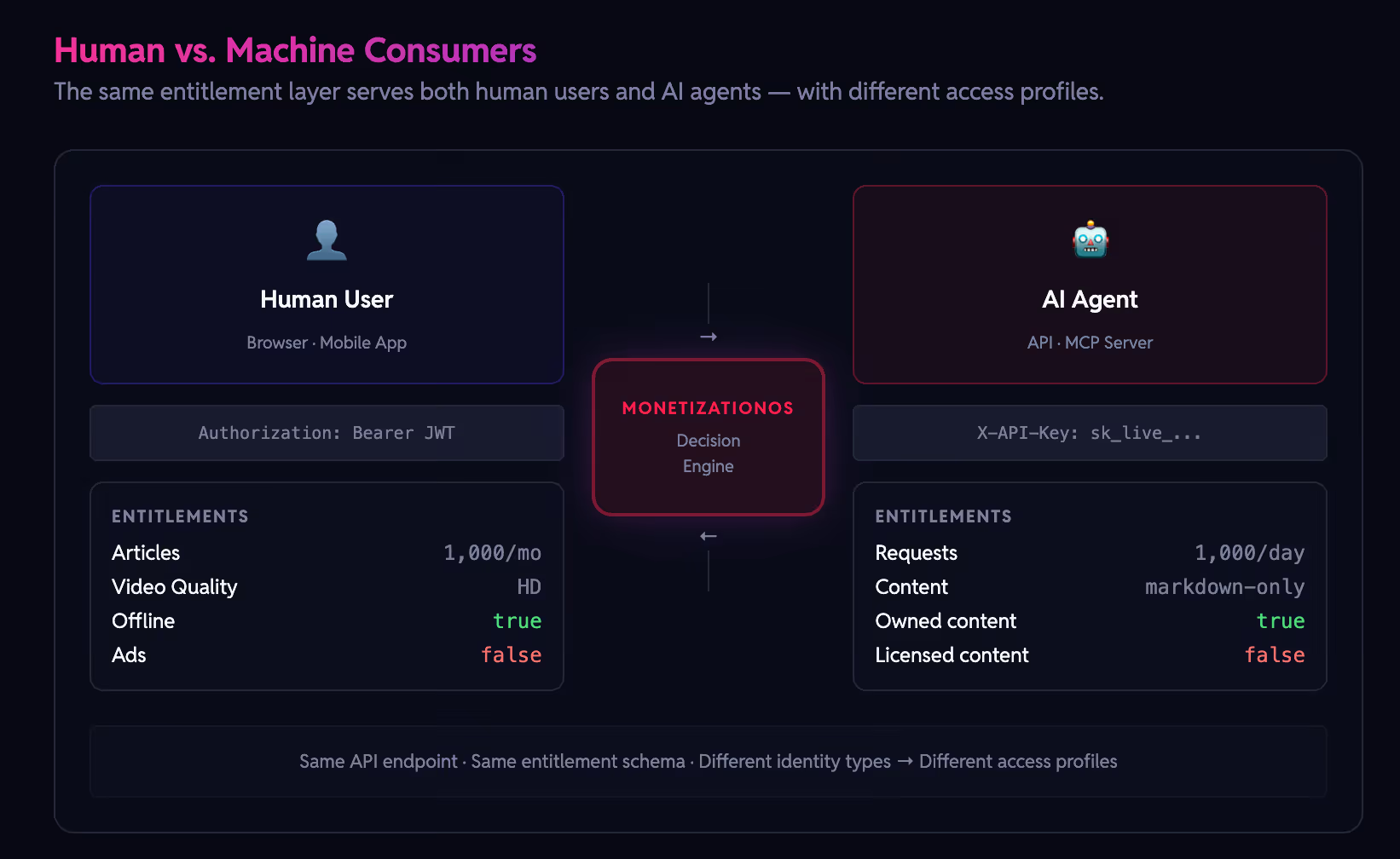
What do all of these developments have in common? They depend on a robust access and entitlement layer to be deployed on. An AI agent requesting content needs to be identified, its permissions evaluated, its access granted, denied or priced. All at machine speed, web scale, and with full auditability. We need to protect the value of our IP short term, but you ultimately don’t win by playing defence.
The real questions are: "How do I reach new customers through structured, entitled access to my knowledge and services, and how do I make them pay fairly for that value exchange?"
Entitlements are the connective tissue that makes both human and machine monetization possible. Without them, rights declarations are unenforceable, payment protocols have nothing to trigger against, and access decisions can't be made at the speed agents require.
<div anchor>The foundation for monetization intelligence</div>
The foundation for monetization intelligence
Clean entitlement infrastructure unlocks the intelligent monetization systems that will define competitive advantage in the coming years.
When entitlements are decoupled, well-instrumented, and queryable in real time, you can A/B test pricing by adjusting rules for user segments, personalise offers based on behavioural signals, implement dynamic retention interventions for at-risk users, and let agents negotiate access terms programmatically.
This is the transition from deterministic rules where a human defines every scenario and rule to probabilistic optimisation, where intelligent systems suggest and test improvements within guardrails humans define. That transition is only possible when the underlying entitlement infrastructure is clean, observable, and programmable.
Entitlements aren't exactly glamorous and headline grabbing (hence this blog post!). But every user of your website or app, every A/B test on pricing, every personalised offer, every dynamic retention intervention, and every agent transaction, flows through them.
In a world where both humans and machines are consuming your content and services, where pricing and access models are evolving rapidly and hybrid models are emerging, they are also the essential infrastructure that will make your monetization strategy work or break.
Entitlements are the unsung heroes of monetization, that’s why we love them at MonetizationOS.
-------------
MonetizationOS is edge-native infrastructure that governs and monetises every access request in real time, from human audiences to AI agents. It comes with 1,000,000 free operations per month, no setup fees, and deploys in hours. Get started for free at monetizationos.com