
For about twenty years, the open web ran on a handshake.
You published content. Search engines crawled it for free. In return, they sent you readers you could turn into subscribers or ad impressions. Nobody signed anything. The deal held because both sides got something: the crawler got data, the site got traffic.
That deal is over.
The numbers behind the break
Even Google's exchange has only ever been a handful of pages crawled per visitor it sends back. The AI crawlers aren't in the same universe: OpenAI's crawler takes around 850 pages for every referral it returns, and Anthropic's closer to 11,000 to one.
The machines take the content and keep the reader. The answer gets synthesized and the click never happens.
The visitors themselves have changed, too. Automated traffic is now a major share of all web traffic - by widely-cited measures, more than half. You don't need the exact figure for your own site to feel the shift. A large and growing share of the requests you serve now come from machines - crawlers, indexers and AI agents - rather than from people.
So here's the uncomfortable position you're in - a fast-growing share of your audience can't subscribe, can't see an ad, and can't click. And the system you built assumes every visitor does all three.
The mistake is treating it as a security problem
Faced with this, the reflex has been to reach for the security team - block the scrapers, tighten robots.txt, and buy a bigger wall.
But that's the wrong department. Blocking is an arms race you don't win - well-funded crawlers rotate IPs, mimic browsers and ignore robots.txt, and you can't out-spend them on evasion. More to the point, blocking treats your most valuable new audience as a threat to be repelled rather than a relationship to be governed.
You don't grow a business by turning away part of your audience at the door.
The ones getting ahead are no longer asking how to keep bots out. Instead, they're asking the most important questions:
- Who is this visitor?
- What are they allowed to do?
- On what terms?
That question applies whether the visitor is a subscriber, a lapsed reader, an anonymous browser or an AI agent.
It's one question, asked of every request. In other words, it's an access question.
Access is the layer
So the shift is from access as a gate bolted onto the front of your site to a strategic layer the whole business runs through.
A real access layer does four things a paywall can't.
- It tells your visitors apart - human or machine - and applies different rules to each.
- It makes the decision before content is served, not after the page has loaded in the browser, which is why most paywalls leak in the first place.
- It lets the business change the rules without filing an engineering ticket.
- It governs people and machines through the same system, because to the infrastructure they're both just requests carrying different entitlements.
That decision has to happen at the edge - at the point of request, in milliseconds - because at machine scale, where a single crawler can hit you hundreds of times a second, a decision made deeper in the stack is a decision made too late.
Where this goes next
You can't charge for access until you govern it, so governing comes first, which puts you in a position to charge once the market is ready.
A market is forming to charge machines for access. The x402 protocol - now an open standard under the Linux Foundation, backed by Coinbase, Cloudflare, Stripe, Visa, Mastercard and Google - revives the dormant HTTP 402 "Payment Required" code so sites can charge machines directly. TollBit is already metering AI access across thousands of sites. And the licensing deals between AI companies and big content owners show that machines will pay for content when there's a commercial deal in place.
None of that is a shipped capability you switch on today, and anyone telling you otherwise is just talking their book. But what you can do now is take control. You can know who is asking, decide what each visitor gets, and protect the content that is your business.
The handshake is gone. Something has to take its place.
The only question worth your time is whether you write the rules for access to your content - or read everyone else's.
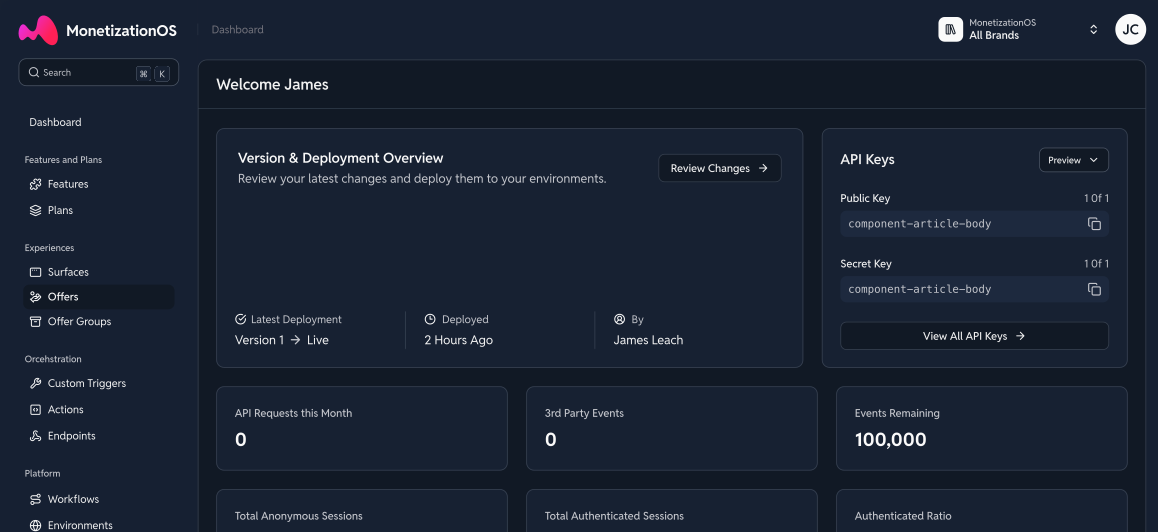
We call this the Future of Access, and it's what we're building MonetizationOS to deliver.