
TL;DR
- Machine traffic overtook human traffic in 2025 and the share is still growing. At this moment in time, most publishers are either blocking everything indiscriminately or doing nothing at all. Both responses leave significant revenue on the table.
- The commercial models for monetizing machine traffic exist right now: machine-to-machine payments via protocols like x402, content marketplaces, programmatic licensing tiered by use case, metered pricing per request, agent-tier plans, and hybrid models where an AI agent acts on behalf of a human subscriber.
- Industry standards are forming around these models. RSL embeds machine-readable licensing terms directly into content infrastructure with actual enforcement mechanisms, not just polite requests. SPUR, backed by the BBC, FT, Guardian and others, is building the shared frameworks that let publishers negotiate from a position of collective strength.
- Standards and coalitions only work if publishers have infrastructure to enforce them at the point of access. A licensing framework that can't be evaluated in milliseconds, for every request, is a policy document rather than a commercial system.
- MonetizationOS is the central decisioning layer that closes the gap: one entitlement engine that classifies every visitor, evaluates commercial rules, and enforces access decisions in real time at the edge, across human subscribers, verified AI agents, and unidentified crawlers alike.
<div anchor>Introduction</div>
In 2025, for the first time in the history of the commercial internet, machine traffic overtook human traffic. In 2026, bots, crawlers, AI agents, and automated systems now account for the majority of requests hitting publisher infrastructure - and that share is growing fast.
Most organisations are responding in one of two ways. Some are blocking aggressively: updating robots.txt, IP-blocking known crawlers, treating every non-human request as a threat. Others are doing nothing at all, either because they don't have visibility into what's accessing their content, or because they haven't figured out what to do about it.
Both responses are leaving money on the table.
Blocking treats all machine traffic as a cost to be eliminated. It isn't. Some of that traffic has genuine commercial value, such as AI companies that would pay for legitimate access, agents acting on behalf of human users, crawlers that drive downstream discovery. Treating every bot the same way is like treating every human visitor the same way: it's a blunt instrument applied to a highly nuanced problem.
Ignoring machine traffic is worse. If you can't see what's consuming your content, you can't govern it. You can't price it. You're subsidising access for entities that are extracting value from your intellectual property at scale, and you're paying the infrastructure costs to serve them.
The opportunity outlined here isn't theoretical. The monetisation models for machine traffic exist right now. What's missing is the infrastructure to implement them.
<div anchor>The monetization models are already here</div>
The monetisation models are already here
The conversation about AI monetisation can often stall at "We should do something about bot traffic.", most likely because the technical and commercial reality is more advanced than that suggestion. But multiple commercial models for machine traffic are emerging right now, and publishers with the right infrastructure can act on them today.
Machine-to-machine payments.
- This scenario sees AI agents transacting autonomously, with no human in the loop. An agent requests content, the system evaluates its identity and entitlements, and a payment is processed or access is denied - all in milliseconds. The infrastructure for this is maturing fast. Protocols like x402 are reviving the HTTP 402 "Payment Required" status code for agent-initiated payments, backed by Coinbase, Stripe, and Cloudflare. MPP.dev is establishing an open standard specifically for machine-to-machine payments - something MonetizationOS is actively building on.
Content marketplaces and data syndication.
- Rather than waiting for AI companies to scrape and hoping for a licensing deal after the fact, publishers package and sell access directly. Structured feeds, curated archives, real-time content APIs - each priced according to the value of the content and the use case of the buyer.
Programmatic licensing.
- Not every AI use case is the same. An agent that reads an article to answer a user's question is different from one that ingests your archive for model training. Tiered licensing frameworks cover read access, synthesis rights, and training rights separately - each at a different price point, each governed by different terms agreed by your business..
Usage-based and metered pricing.
- Flat subscriptions don't map to how machines consume content. An AI agent might make 10,000 requests in a day or none at all. Metered pricing aligns the cost to actual consumption - per request, per article, per data call - rather than forcing machine customers into human subscription models that don't fit.
Agent-tier plans.
- The same plan architecture that governs human subscribers, applied to machine customers. An AI agent gets a plan with defined entitlements: which content it can access, at what volume, under what terms, with what usage caps. The entitlement logic is identical. The customer type is different.
Verified agent credentialing.
- As the agent ecosystem matures, identity becomes a commercial asset. Verified agents with declared purposes, audit trails, and usage reporting get preferential access and pricing. Unverified agents get blocked or rate-limited. Identity isn't just a security mechanism - it's a pricing input.
Affiliate and referral models.
- Some agent interactions drive downstream human traffic that converts. An AI assistant that recommends an article and sends a reader to your site has referral value. Capturing that downstream conversion and attributing it back to the agent creates a model where machine traffic that generates human revenue is treated - and priced - accordingly.
Hybrid monetisation.
- This is the most complex and fastest-growing model. A human user asks an AI agent to access content on their behalf. The agent hits your infrastructure, prompting the question: is it a human request or a machine request? The reality is both. The entitlement framework needs to govern the human's subscription status and the agent's access rights simultaneously, through a single, instant decision.
<div anchor>The standards forming around machine access</div>
The standards forming around machine access
These monetisation models don't operate in a vacuum. An emerging set of open standards is beginning to define how machine access to content should work, which matters commercially because standards shape what becomes enforceable and what will become industry norm.
Robots.txt has been the web's basic signalling mechanism for decades, a simple file telling crawlers what they can and can't access. But it was designed for search engines, not commercial AI, and compliance is entirely voluntary. It can tell a crawler to stay out. It can't tell it what to pay.
RSL - the Really Simple Licensing standard - goes significantly further. It's an open standard that lets publishers embed machine-readable licensing and compensation terms directly into their content infrastructure, covering everything from free attribution through to pay-per-crawl and pay-per-inference models. The critical difference from robots.txt is that RSL includes an actual compliance mechanism: crawlers must present an authorisation token as part of the network request, which gives publishers a technical basis for enforcement rather than just a polite request. The first stable specification - RSL 1.0 - was published in December 2025, with support from infrastructure providers including Cloudflare and Akamai, meaning enforcement can operate at the network level for publishers who choose to configure it that way. MonetizationOS enforces RSL terms at the edge as part of the access decision — the same system that evaluates a human visitor's entitlements can evaluate a machine visitor's licensing credentials in the same request.
Standards matter here because they fundamentally change the commercial conversation. A publisher citing RSL terms is operating within an industry framework. A publisher with no declared terms is starting from scratch in every negotiation.
<div anchor>The industry coalition shaping the rules</div>
The industry coalitions shaping the rules
Alongside the technical standards, a parallel movement is building at the industry level, publisher groups pushing to establish the commercial and legal frameworks that will govern how AI companies access content at scale.
SPUR - the Standards for Publisher Usage Rights coalition - was founded by the BBC, Financial Times, The Guardian, Sky News, and Telegraph Media Group, with an explicit mission to build shared technical standards and licensing frameworks that give AI developers legitimate access to journalism while guaranteeing publishers retain control and receive fair compensation. SPUR isn't a collective pricing body - individual publishers remain free to negotiate their own commercial terms - but the coalition is designed to reduce duplicated effort, strengthen negotiating leverage with technology companies, and present a unified set of expectations to policymakers.
The RSL Collective (the nonprofit organisation behind the RSL standard), draws a direct parallel with how ASCAP and BMI operate in music: pooling rights across millions of publishers to create standardised licensing that AI companies can access at scale, rather than requiring thousands of bilateral deals to be negotiated individually.
These aren't fringe initiatives. The FT's deal with OpenAI, the AP's licensing partnerships, Schibsted's real-time content agreement - the bilateral deals are multiplying. The coalitions and standards are the infrastructure being built so that those deals don't have to be negotiated from scratch every time, and so that publishers of all sizes can participate in the market rather than just those with the resources to negotiate directly with the largest AI companies.
But standards and coalitions only work if publishers have the infrastructure to enforce them. A licensing framework that exists on paper but can't be evaluated and enforced at the point of access, in real time, for every request, is a policy document rather than a commercial system. That enforcement layer - the ability to read an agent's credentials, evaluate them against your declared terms, and make an access decision in milliseconds - is where infrastructure like MonetizationOS turns industry standards into operational revenue.
<div anchor>Not everything gets charged</div>
Not everything gets charged
The temptation, once you have visibility into machine traffic, is to monetise everything. That's as much of a mistake as blocking everything.
Some machine traffic has downstream value that exceeds what you'd earn by charging for it directly. Googlebot indexes your content and drives organic search traffic that converts to subscribers and generates advertising revenue. Certain accessibility tools serve disabled readers. Publisher-specific crawlers support content syndication partnerships you've already agreed to.
The right approach isn't a blanket rule. It's a decision matrix: allow, charge, or block - based on agent identity, declared purpose, and downstream value. A verified Googlebot gets free access because its downstream value is well understood. An AI training crawler gets metered access at a price that reflects the value of what it's consuming. An unidentified scraper with no declared purpose gets blocked.
That decision needs to happen in real time, at the point of access, with full context about who the visitor is and what they're entitled to. And it needs to be governed by commercial logic, not just security rules.
Blanket blocking isn't a strategy. It's a cost centre masquerading as a policy.
<div anchor>The infrastructure gap</div>
The infrastructure gap
The opportunity is understood and commercial applications are in advanced stages. What's missing is the infrastructure to act on them.
It’s not too great an assumption to say that most publishers have some combination of the following:
- A CDN that handles delivery but has no commercial logic
- A web application firewall that can block bots but can't price them
- A paywall that governs human subscribers but can't identify or classify machine visitors
- A billing system that was built for recurring subscriptions but has no framework for metered machine access.
Each of these tools does its designated job, but none of them does the job that machine monetisation actually requires: identifying every visitor at the point of access, classifying it by type and intent, evaluating its entitlements, applying commercial rules, and enforcing the decision - all in real time, before content is served.
Network-level security tools handle traffic classification at the infrastructure layer, but they have no capabilities for pricing, entitlements, or commercial logic. They can tell you a request came from a bot. They can't tell you whether that bot has a licensing agreement, what tier of access it's entitled to, or what it should be charged.
Point solutions that charge crawlers at the point of access solve a narrow problem but don't extend to hybrid traffic, plan architecture, or the broader entitlement management that publishers need across both human and machine audiences. They're a feature, not a platform.
The risk for publishers who assemble a collection of point solutions - one tool for bot blocking, another for crawler pricing, a separate paywall for humans, and yet another system for licensing management - is a fragmented stack with no single control plane. Every new vendor is another integration to maintain, another data silo to reconcile, and another system that can't see what the others are doing.
<div anchor>Why this requires a central decisioning layer</div>
Why this requires a central decisioning layer
The only way to govern machine traffic commercially - not just technically - is with a layer that sits between your content and every visitor type, making intelligent decisions in real time.
That layer needs to do several things simultaneously::
- Identify every visitor at the point of access: human subscriber, anonymous reader, verified AI agent, unidentified crawler, accessibility tool, licensing partner.
- Evaluate what each visitor is entitled to, based on their identity, their plan, their usage history, and your commercial rules.
- Enforce entitlements instantly - granting access, denying it, metering it, or pricing it - before the content is served.
- Give commercial teams the ability to change the rules without engineering involvement, so the business can adapt at the speed the market demands.
<div anchor>This is what Monetization OS does</div>
This is what MonetizationOS does
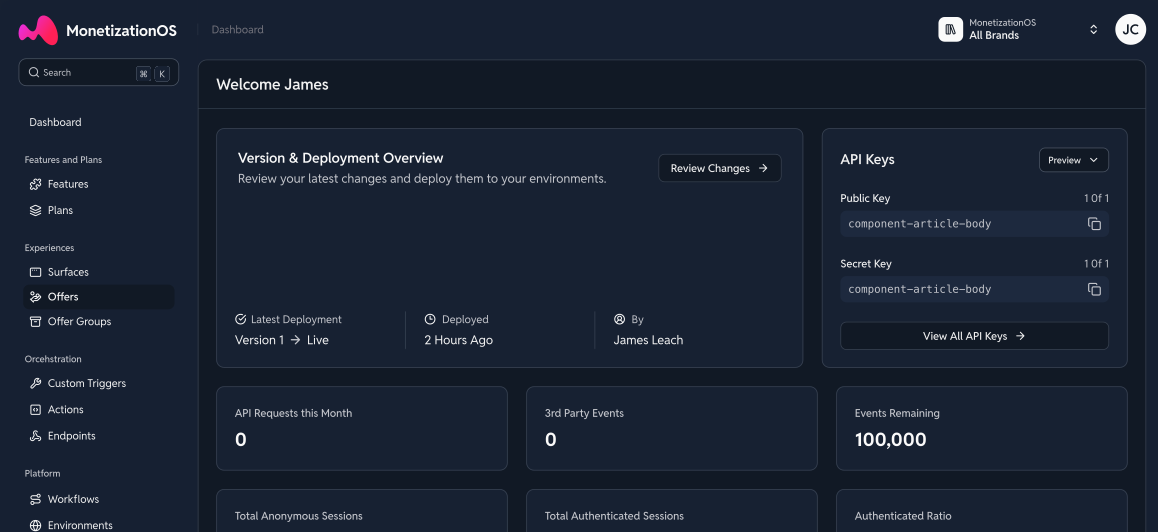
MOS is the infrastructure layer between your content and every access request - human or machine. It classifies every visitor in real time, evaluates entitlements through a single engine, and applies commercial rules instantly at the edge.
- One entitlement model governs humans, agents, crawlers, and bots.
- One system holds pricing rules, access decisions, and usage caps.
- Commercial teams can change pricing, create new agent tiers, adjust metering thresholds, and launch licensing offers without writing a ticket.
- Enforcement is automatic.
- Metering is built in.
- The entire decision is observable and explainable.
The entitlement architecture that governs a human subscriber's access to articles is the same architecture that governs an AI agent's metered access to your archive. The plan framework that lets you create free, standard, and premium tiers for readers lets you create equivalent tiers for machine customers - with different access rights, different usage limits, and different pricing. It's one system, one set of commercial rules, applied to fundamentally different visitor types through a single decisioning layer.
The opportunity in AI monetisation is well understood at this point. Every publisher knows machine traffic is growing, and every publisher knows their content has value. The gap has never been awareness or the commercial desire - it's been the infrastructure to act on it. That's what MonetizationOS has been built to close.
-------------
MonetizationOS is edge-native infrastructure that governs and monetises every access request in real time, from human audiences to AI agents. It comes with 1,000,000 free operations per month, no setup fees, and deploys in hours. Get started for free at monetizationos.com