
This article was written in partnership with Mather Economics.
<div anchor>TL;DR</div>
TL;DR
- AI crawlers now generate more traffic than humans at many publishers, with some increasing request volume by over 300% while referral traffic plummets
- Legacy paywalls were built for human readers and pageview counting - they can't identify different bot types, meter machine consumption, or enforce licensing terms for AI traffic
- Publishers are losing revenue on both sides: human visitors are harder to convert with rigid one-size-fits-all paywalls, while machine consumers extract intellectual property without compensation
- The infrastructure gap is architectural - traditional systems make decisions too late, lack bot classification capabilities, and couple access logic to billing systems that can't handle anonymous or machine traffic
- Next-generation platforms like the Sophi Paywall powered by MonetizationOS solve this by making real-time entitlement decisions at the edge, distinguishing human from machine traffic, and enabling dynamic pricing and AI licensing across all audiences
<div anchor>AI is disrupting the economic bargain of the internet</div>
AI is disrupting the economic bargain of the internet
In the past twenty-five years, publishers cycled through more revenue models than the previous century combined. Free access gave way to banner ads, then hard paywalls, then metered access, freemium models, and subscription tiers. Each approach lasted a few years before the economics shifted and publishers rebuilt their monetization infrastructure from scratch.
The dynamics are shifting again - but this time the complexity is unlike anything that came before.
Three pressures are converging simultaneously. Costs keep rising while revenue hasn't kept pace. Audiences have fragmented into hundreds of micro-segments with different consumption patterns and varying willingness to pay. And large language models are consuming intellectual property at unprecedented scale, training on original reporting and redistributing insights without attribution or compensation.
In January 2026, Cloudflare articulated what publishers already sensed: AI is disrupting the web's foundational economic bargain. For decades, the internet ran on a straightforward exchange - creators share content, platforms send traffic back. That traffic was currency. It funded journalism by bringing readers who might subscribe or see advertisements.
AI is breaking that exchange.
<div anchor>The Scale of the Shift</div>
The Scale of the Shift
The numbers tell the story. For every 28,400 HTML pages requested by a prominent AI crawler, it referred back just one visit to the original source. Combined traffic from search engines and AI crawlers grew 19% in 2025, with some crawlers increasing request volume by more than 300%. Meanwhile, unique visitors to U.S. news sites fell 13% and pageviews dropped 17%.
This isn't an episodic dip that will self-correct when economic conditions improve. It's structural attrition - a permanent shift in how audiences discover and consume news. When someone asks their AI assistant about breaking developments or background context, the system synthesizes answers from multiple sources. The user gets what they need without ever visiting the publisher's site. The journalism still has value. The traffic that once monetized it has vanished.
<div anchor>Value Hasn't Moved - Capture Has</div>
Value Hasn't Moved - Capture Has
The core source of value hasn't changed. Original journalism - the careful reporting, fact-checking, and synthesis that distinguishes news from noise - remains essential. What changed is who captures the value it creates.
Human visits are harder to earn and easier to lose, which raises the stakes of every paywall interaction and conversion attempt. At the same time, machines consume journalism at scale that dwarfs human readership, and they do it entirely outside existing monetization infrastructure.
Publishers theoretically hold leverage here. If high-quality original reporting disappears, AI models degrade. They cannot sustain themselves by extracting from the internet indefinitely - model collapse becomes a real risk when training data quality deteriorates. But leverage only matters if you can act on it, and most publishers cannot.
The infrastructure that governs access to their journalism wasn't built for this reality.
<div anchor>Why Legacy Paywalls Can't Solve This</div>
Why Legacy Paywalls Can't Solve This
The paywall infrastructure most publishers rely on wasn't necessarily built badly. It was built for a different internet.
In 2006, the central question was simple: should this reader get access? Publishers needed systems that could count article views, enforce metering limits, and present subscription offers when readers hit their allowance. That infrastructure worked because the web was relatively uniform - browsers requesting HTML pages, readers clicking links, straightforward pageview metrics.
In 2026, the question is fundamentally different: who is making this request, what is it worth, and what is the right exchange?
Machine traffic and AI crawlers already approach or exceed human traffic across many publisher platforms, and that proportion keeps growing. Legacy paywalls were designed for a web of anonymous readers and simple pageview counting. They were never built for a market where machines are systematic, high-volume consumers of intellectual property operating with completely different access patterns than human readers.
The architectural limitations are significant. Traditional paywalls make access decisions after requests reach application servers, which means bot traffic has already consumed infrastructure resources before getting identified. They rely on client-side JavaScript for metering and detection, which sophisticated crawlers easily circumvent. They couple access logic to billing systems, making it impossible to make intelligent decisions about anonymous users or machine consumers who don't exist as subscribers. And they lack any framework for distinguishing between different types of non-human traffic - search engines indexing for discovery, accessibility tools serving disabled readers, and AI systems extracting content for training all get treated identically.
The result is predictable: revenue left uncollected, licensing power unrealized, intellectual property consumed without governance or compensation.
You cannot price what you cannot identify. You cannot govern what you cannot see. You cannot monetize audiences your infrastructure wasn't designed to handle.
This shift transforms the paywall from a simple access gate into core infrastructure that determines whether publishers can capture value in an AI-driven internet.
<div anchor>What Next-Generation Infrastructure Does Differently</div>
What Next-Generation Infrastructure Does Differently
The challenge is that most publisher monetization platforms were built before machine consumption became significant. Systems designed in 2015-2020 couldn't anticipate AI crawlers becoming a major traffic source, which means they lack the architectural flexibility to handle this shift. Commercial teams can't experiment with machine licensing because the systems can't distinguish bot types. Engineering teams spend months implementing what should be configuration changes.
A new generation of paywall technology is required - systems designed to identify audiences accurately, price demand dynamically, and govern both human and machine access from a unified infrastructure layer.
Sophi Paywall, powered by MonetizationOS, represents this evolution in publisher monetization. Unlike traditional paywalls, next-generation systems operate on two foundational principles that address the architectural limitations of legacy approaches:
Strategic Sovereignty
Publishers must know who is in their building - distinguishing human readers from machine consumers, recognizing intent, and enforcing differentiated access rules across audiences.
This happens at the edge, before requests reach application infrastructure and consume resources. Edge-based classification means bot traffic that shouldn't access your content never touches your servers, never distorts your analytics, and never costs you bandwidth. Legitimate machine consumers get routed to appropriate licensing pathways based on their identity and terms.
Modern paywalls let publishers say yes, no, or yes at this price for every request, with the granularity to distinguish between search engines indexing for discovery, AI companies training models, accessibility tools serving readers, and unlicensed scrapers extracting value without permission. Each type of consumer can be governed independently with rules that reflect their actual commercial relationship to the publisher.
Fair Value Exchange
The question shifts from can they enter to what is this request worth - for both human and machine audiences.
For human readers, that means dynamic pricing across the full demand curve. A loyal subscriber who visits daily gets frictionless access. A casual reader arriving from social media sees metered access calibrated to their engagement level. A first-time visitor from organic search receives extended access to build familiarity before encountering conversion prompts. The system adapts based on behavioral signals - referral source, content preferences, session frequency, engagement patterns - without requiring engineering work for each new strategy.
For machine traffic, it introduces entirely new monetization models: AI licensing tiers based on usage volume, usage-based access with precise consumption tracking, metered AI ingestion that resets monthly or annually depending on terms. Every machine consumer - whether it's a search crawler, an AI training system, or an aggregator building derivative products - receives the appropriate access at the appropriate price based on the value exchange both parties agreed to.
The infrastructure tracks everything: human pageviews, machine API calls, partial content access, full archive consumption. When an AI company knows exactly what content it consumed and pays fairly for that usage, it establishes the transparent value exchange that makes ongoing partnerships sustainable. When publishers can demonstrate precise usage metrics and enforce licensing terms programmatically, they gain confidence to invest in quality journalism knowing that all their audiences contribute to its sustainability.
<div anchor>The Technical Architecture That Makes This Possible</div>
The Technical Architecture That Makes This Possible
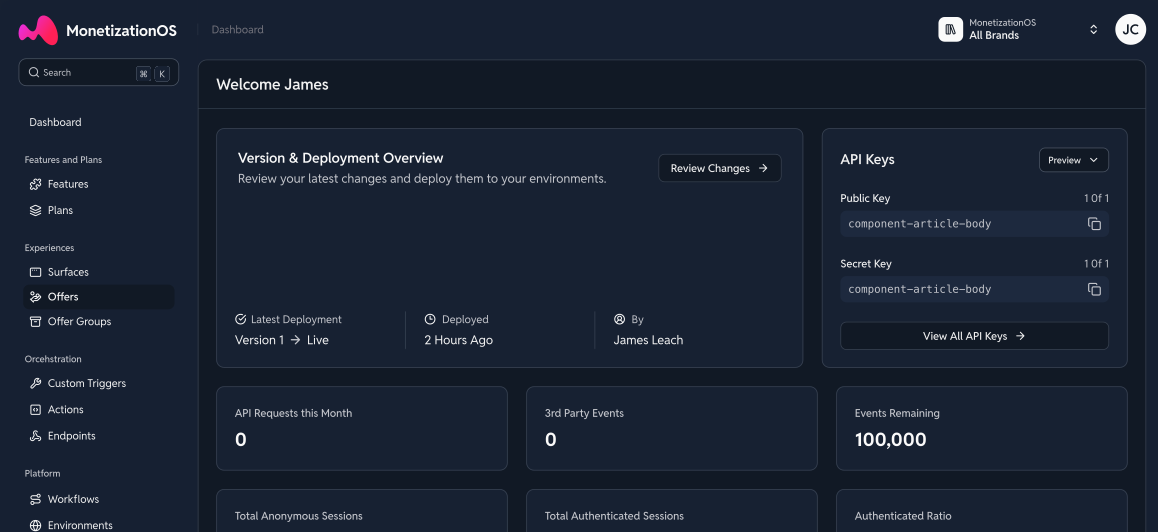
This isn't theoretical infrastructure that will exist in some distant future. The Sophi Paywall powered by MonetizationOS deploys in hours, not months, because it's built on edge-native decisioning that integrates with existing publisher tech stacks without requiring extensive custom development.
The system makes real-time entitlement decisions at the CDN edge - identifying traffic type, evaluating permissions, applying business rules, and returning access decisions before content delivery. This architecture solves the latency problem that kills traditional personalization approaches. When paywall decisions add 250 milliseconds to page load times, you lose readers before your sophisticated targeting even gets a chance to work. Sub-50ms edge decisions mean both human and machine audiences get instant responses while publishers maintain complete control over who accesses what under which terms.
Updates to monetization strategy don't require development cycles. Commercial teams can test new metering approaches for human audiences, adjust AI licensing terms, refine conversion thresholds, and experiment with promotional access based on performance data - all without engineering tickets. You're not locked into decisions made months ago when market conditions were different. You can adapt as you learn what actually drives conversion and retention for each audience segment.
<div anchor>Building for What's Coming</div>
Building for What's Coming
The question isn't whether machine traffic will keep growing or whether AI systems will consume more journalism. They will. The question is whether publishers build infrastructure for this reality now while they still have negotiating leverage, or scramble to catch up later when the economics have shifted further against them.
We've seen this pattern repeatedly in digital publishing. The platforms that adapted early to programmatic advertising, to mobile traffic, to subscription-first models - they survived and sometimes thrived. The ones that waited, hoping the old models would persist, found themselves negotiating from positions of weakness when the market finally forced their hand.
Publishers using next-generation infrastructure like the Sophi Paywall are already converting what was pure cost - bot traffic consuming infrastructure without contributing revenue - into protected revenue streams through structured AI licensing. They're using behavioral signals to optimize human conversion paths without adding engineering overhead. They're governing access to their intellectual property with the precision that modern economics demand.
<div anchor>Moving from Defense to Offense</div>
Moving from Defense to Offense
Every major shift in media rewards the publishers who recognize the new reality early and adapt their strategies accordingly. That moment has arrived.
AI is reshaping how journalism gets discovered and consumed. Demand now comes from multiple directions - loyal readers, casual visitors, search engines, and increasingly AI systems capable of ingesting entire publications in seconds. Operating in this environment requires more than traditional access control. It requires infrastructure capable of understanding who is requesting content, what that demand is worth, and how it should be monetized across both human and machine audiences.
The Sophi Paywall, powered by MonetizationOS, is designed for this shift - giving publishers the ability to distinguish human audiences from machine consumers, dynamically price access based on actual behavior and intent, and govern how their journalism is used across an increasingly complex digital ecosystem.
With this infrastructure in place, publishers can move beyond reacting to disruption and begin operating from a position of strength. The journalism still has value. The question is whether the infrastructure exists to capture it fairly from everyone who consumes it - human or machine.
Your biggest consumers aren't all human anymore. Your monetization infrastructure should reflect that reality.
-------------
MonetizationOS is edge-native infrastructure that governs and monetises every access request in real time, from human audiences to AI agents. It comes with 1,000,000 free operations per month, no setup fees, and deploys in hours. Get started for free at monetizationos.com