
TL;DR
- Two historical moments rewrote how every business thought about its addressable market. The standardised shipping container expanded what manufacturers could sell from what fits in a truck to what fits in a global supply chain. The iPhone expanded every digital service from desktop reach to whatever a phone could touch.
- The same kind of moment is opening today. Half of web traffic is now non-human, the infrastructure for AI agents to pay for what they consume is live, and the customers showing up at your endpoints already exist.
- Most companies' infrastructure for deciding what to charge them was built for human users only. The companies closing the gap between TAM and SAM in the next twelve months will set the price points everyone else gets benchmarked against.
Shipping Containers and iPhones
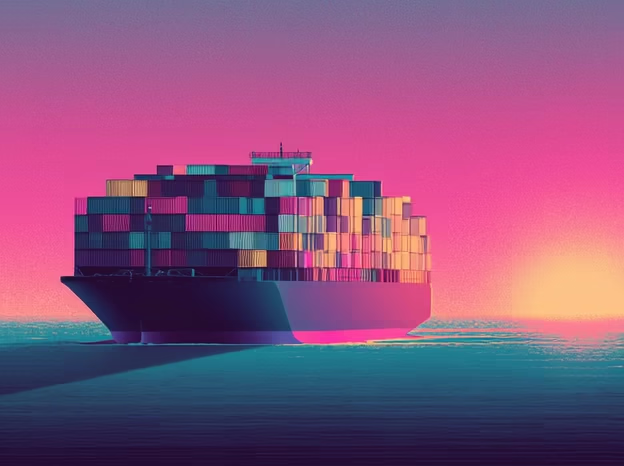
In 1956, a former trucking executive called Malcolm McLean watched fifty-eight standardised steel containers being loaded onto a converted tanker called the Ideal X in Newark. The voyage from New Jersey to Houston cost a fraction of conventional break-bulk shipping, and the container business that grew out of it expanded the addressable market of every manufacturer in the developed world from "what we can sell within trucking distance of our factory" to "what we can sell anywhere a container can travel." The ports that retooled for containers became the centres of global trade for the next half-century. The ports that didn't, including most of the historic ones that had handled shipping for two hundred years, were largely irrelevant within twenty.
Fifty years later, in January 2007, Steve Jobs unveiled the iPhone. Within a decade every business with a digital service had its TAM rewritten. The companies that built native mobile experiences early, including Dominos, Bank of America and Starbucks, captured the new market, while the companies that treated mobile as a smaller version of the desktop site for years lost ground that took a decade to recover.
Both moments share a shape. A new piece of infrastructure became available, the total addressable market of every business doing relevant commerce expanded by a multiple, and the serviceable addressable market did not move with it because the infrastructure each business needed in order to actually transact with the new customers had to be built. The companies that invested early captured the expansion, while the companies that waited got benchmarked against them on terms set by the early movers.
The same kind of gap is opening today, in every sector with digital assets to sell.
More than half of all web traffic is now non-human. AI agents, crawlers, autonomous services and machine-to-machine integrations are showing up at your endpoints in real volumes, and they are increasingly willing to pay for what they consume. Stripe and Tempo shipped the Machine Payments Protocol earlier this year, Stripe launched Link CLI (which gives an AI agent a working wallet on a real card network), and the x402 Foundation has now moved under the Linux Foundation with Cloudflare, Stripe, Visa, Google and AWS at the governing table. Browserbase is already charging agents per session for headless browsers, Parallel charges them per API call for web access, and a New York deli is taking machine payments for sandwiches (Prospect Butcher Co. now enables AI agents to order sandwiches for human pickup or delivery across New York City).
The plumbing is real, the customers exist, and they are arriving at your endpoints today. Most businesses' infrastructure for deciding what to charge them, however, was built for human users only. The paywall, the API rate limiter, the access-control logic, the billing flow: all of it assumed the visitor on the other side was a person with an account. When a machine arrives at the same endpoint, the system has two answers available: block it, or let it through for free. Neither of those captures revenue or treats the machine as a customer. The gap between TAM and SAM is the cost of running a 2018 access architecture in a 2026 market.
Publishing is the canary
Publishing is feeling this first because its core asset (content) is the most directly extractable by machines. Crawler volumes are highest there, AI training pipelines hit publisher sites hardest, and agentic browsers like ChatGPT Atlas and Perplexity Comet read newspapers in milliseconds and never visit a paywall. The traffic data on a typical UK publisher site this year shows non-human requests running ahead of human ones, often by a meaningful margin, and the trend is one direction.
Publishers are also moving fastest because they have to. The economics of the open web depended on advertising attention, and machine traffic does not watch ads. Subscriptions only address the human half of the audience. The publisher CFOs who looked at the numbers eighteen months ago and saw a cost line have started looking at the same numbers and seeing a revenue opportunity, provided the infrastructure exists to charge for access without breaking the human funnel. The early adopters are the ones introducing that infrastructure now; the late adopters will be the ones licensing access from someone else's marketplace at someone else's prices in eighteen months' time.
Publishing is the canary in the coalmine for everyone else, because the asymmetry is most visible there first. The same question is now arriving in every sector with digital assets to sell.
Every sector with digital assets is next
Stock photography, market research, financial data, legal databases, healthcare information, code repositories, training corpora, structured product catalogues, scientific literature, learning content, satellite imagery, weather data, sports statistics. Every one of these is a service whose addressable market doubled when machines became willing buyers. But almost every one of these is sitting on infrastructure that was built before machines were buyers at all.
The same is true of B2B SaaS in a slightly different shape. Your customers' AI agents are starting to hit your APIs alongside your customers' humans, and your rate-limiting logic, your seat-based pricing model, your trial logic and your usage metering were not designed to distinguish a human user from an autonomous agent acting on the human user's behalf. Some of those agents will be operating under their company's credentials and should pass through. Others will be unaffiliated, third-party, or running unauthorised. The ability to tell the difference at the moment of the request, and to apply different commercial terms accordingly, is the difference between an expanded SAM and an expanded support ticket queue.
Every business that sells digital access has the same emerging set of questions: who is the requester, what are they entitled to, what is the right price for this requester at this moment, and should the answer be different than it would be for a human asking for the same thing? These questions can be answered, and the infrastructure to answer them in real time, at the edge, on every request, exists today. What most companies do not yet have is the layer that brings the answers together.
You don't need two stacks
The first reflex when faced with machine traffic as a commercial category is to bolt on a second monetisation stack alongside the existing one: a human paywall on one side, a separate bot governance system on the other, two billing flows, two analytics streams, two sets of business logic that drift apart over time. This is what most companies will do, and it is the wrong answer, because it produces two systems where you wanted one platform, with a commercial team that can't see the whole picture in either and an engineering team maintaining two integrations that need to agree and won't.
The platform that wins this category is the one that governs both audiences through a single entitlement layer. One system that classifies the requester (human, agent, crawler, partner integration), evaluates the request, checks for existing rights, and decides what to serve and at what price. Same architecture for the human subscriber, the autonomous purchasing agent, the AI training crawler, the partner API consumer and the unidentified scraper, with different commercial outcomes routed through a single decision layer.
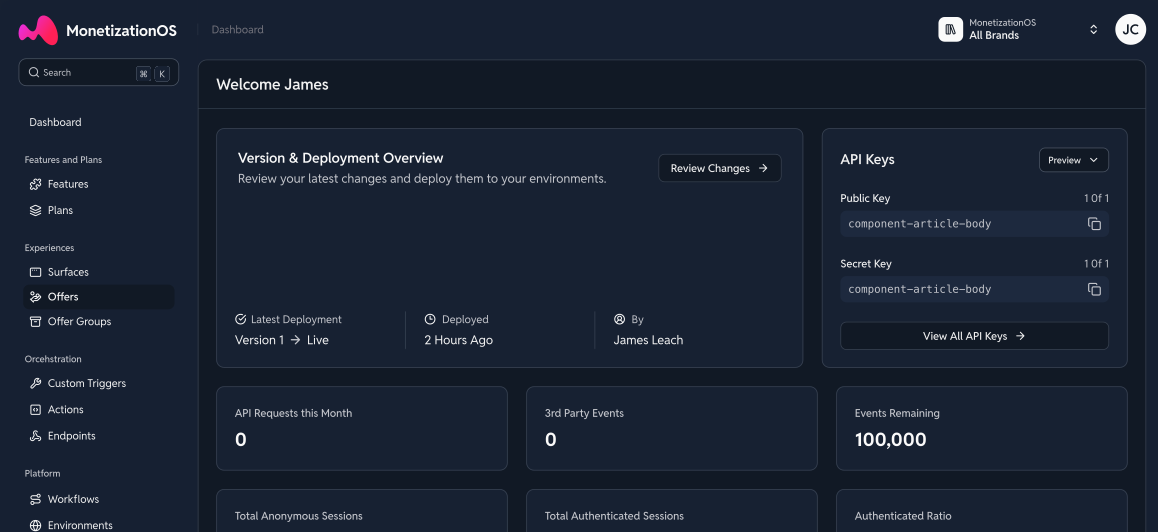
That is the layer MonetizationOS has been building.
Why this matters now
The companies that close the gap between TAM and SAM in the next twelve months are going to set the price points the rest of the market gets benchmarked against. They will be the ones in the pricing conversations with frontier AI labs, the ones inside the standards bodies defining how machine commerce works, the ones whose commercial terms become the reference point for the next decade.
The companies that wait will discover that the commercial relationships have already been negotiated, the licensing rates already set, and the architecture they need to compete is something they don't have. The infrastructure is being built today, and the early adopters are already inside it.
Publishing is leading because publishing has to, but this is not a publishing problem. It is a digital-economy problem arriving in every sector with digital assets to sell, on a timeline most strategy decks haven't yet drawn.
The question for any commercial leader looking at their addressable market this week is whether machine traffic has moved the total. If it has, the follow-up is whether the serviceable side has moved with it, and if it hasn't, the gap between the two is the strategic decision sitting on the desk. The infrastructure is built, the protocols are converging, and the early movers are already inside.
-------------
MonetizationOS is edge-native infrastructure that governs and monetises every access request in real time, from human audiences to AI agents. It comes with 1,000,000 free operations per month, no setup fees, and deploys in hours. Get started for free at monetizationos.com