
TL;DR
- Your highest-volume content consumers aren't human subscribers. LLMs and AI scrapers ingest journalism at a scale that dwarfs human readership, entirely outside existing revenue models.
- Current monetization infrastructure was built for human behaviour only. Paywalls, ad systems and subscription platforms have no way to meter, measure or capture value from machine consumption.
- Blanket blocking isn't the answer. It catches legitimate machine readers alongside bad actors, forfeits potential licensing revenue, and does nothing to solve the underlying economic problem.
- The solution is dynamic licensing: different pricing and access terms for different machine types, metered accurately at the CDN edge in sub-50ms without adding latency or building a custom integration mess.
- Machine traffic is growing and won't stop. Publishers who build infrastructure for it now negotiate from strength. Those who wait subsidize AI development with journalism's dwindling resources until the leverage is gone.
Your Biggest Reader Isn't Human
<div anchor>Introduction</div>
The most loyal consumer of your journalism never clicks an ad, never shares on social media, and never converts to a paid subscriber. It’s also not human. It's a large language model systematically ingesting your content to train AI systems, or an aggregator scraping your archive to synthesize answers for its users.
While newsrooms obsess over reader engagement metrics and subscription conversion rates, machines consume journalism at a scale that dwarfs human readership - and they do it entirely outside existing revenue models. This isn't hypothetical. It's happening now, at massive scale, and traditional monetization infrastructure has no way to measure it, meter it, or capture value from it.
<div anchor>The Invisible Audience</div>
The Invisible Audience
Publishers are investing millions in sophisticated subscriber acquisition funnels, personalization engines, and engagement optimization. Every human visitor gets tracked, scored, and funneled through carefully calibrated conversion paths. Meanwhile, their actual highest-volume consumers are operating in complete darkness.
Current monetization infrastructure was built entirely for human behavior. Paywalls count article views. Ad systems track impressions and clicks. Subscription platforms measure engagement through time spent reading and pages per session. None of these mechanisms were designed to meter machine consumption, which means publishers fundamentally cannot track their most significant audience or establish any compensation framework for it.
The asymmetry is stark. When a human reader consumes ten articles monthly, publishers deploy sophisticated systems to track every interaction, optimize conversion funnels, calculate lifetime value, and personalize the next offer. When an LLM ingests an entire archive to improve its knowledge base, that consumption happens in complete darkness—no measurement, no attribution, no monetization. The result is a massive value transfer from publishers to technology platforms, with journalism funding AI advancement that may ultimately compete with traditional news distribution.
<div anchor>Why Blocking Doesn't Work</div>
Why Blocking Doesn't Work
The instinctive response is to block machine readers entirely - treat all bots as threats and protect content through increasingly aggressive detection and blocking. We understand the impulse. Publishers watched platforms extract value for years while contributing little back, and the reflex to protect what's left makes sense.
But blocking creates its own problems. Legitimate machine readers - search engines that drive discovery, accessibility tools that serve disabled readers, archival systems that preserve journalism - get caught alongside the scrapers you actually want to stop. The arms race between detection and evasion escalates endlessly, consuming engineering resources without solving the fundamental economic problem. And critically, blocking forfeits potential revenue from machine readers who would pay for legitimate access if you offered it.
The web is roughly 50% bot traffic today and that proportion keeps growing, which means treating all non-human traffic identically leaves massive value on the table. Some of those bots represent legitimate use cases with commercial value. Some power AI systems that millions of people rely on for information access. Blanket blocking doesn't distinguish between value extraction and value creation - it just shuts everything down.
<div anchor>Monetizing Machine Consumption</div>
Dynamic Licensing: Monetizing Machine Consumption
The solution isn't blocking machine readers - it's recognizing them as a legitimate audience segment that requires different monetization approaches than human subscribers. This means evolving from subscription-only thinking to dynamic licensing frameworks that acknowledge both human readership and machine consumption as valuable but fundamentally different forms of engagement.
Publishers don't just sell articles for human consumption. They sell high-quality, fact-checked information that serves multiple purposes across multiple audience types. A single investigative piece might inform human readers making civic decisions while simultaneously training an AI system that helps millions access reliable information. Both uses have value. Both should generate revenue. The infrastructure question is how to meter different consumption patterns and enforce different terms without building an unmaintainable mess of custom integrations.
Dynamic licensing means creating differentiated pricing and access models based on use case and consumption volume. Human readers continue with familiar subscription options - metered paywalls, registration walls, premium tiers. Machine readers operate under licensing agreements that reflect their distinct consumption patterns: an LLM training on your archive pays differently than a search engine indexing for discovery, which differs from an accessibility tool providing text-to-speech conversion.
This isn't about restricting access. It's about ensuring that value extraction corresponds with fair compensation, and that the infrastructure exists to enforce those terms at the edge where decisions actually happen.
<div anchor>The Infrastructure Problem</div>
The Infrastructure Problem
The technical challenge is real. Metering machine consumption accurately requires distinguishing between different bot types, tracking usage patterns that don't map to pageviews, and enforcing licensing terms programmatically without adding latency that degrades user experience. Managing multiple simultaneous licensing relationships - each with different terms, different consumption patterns, different billing cycles - quickly becomes unmaintainable without proper infrastructure.
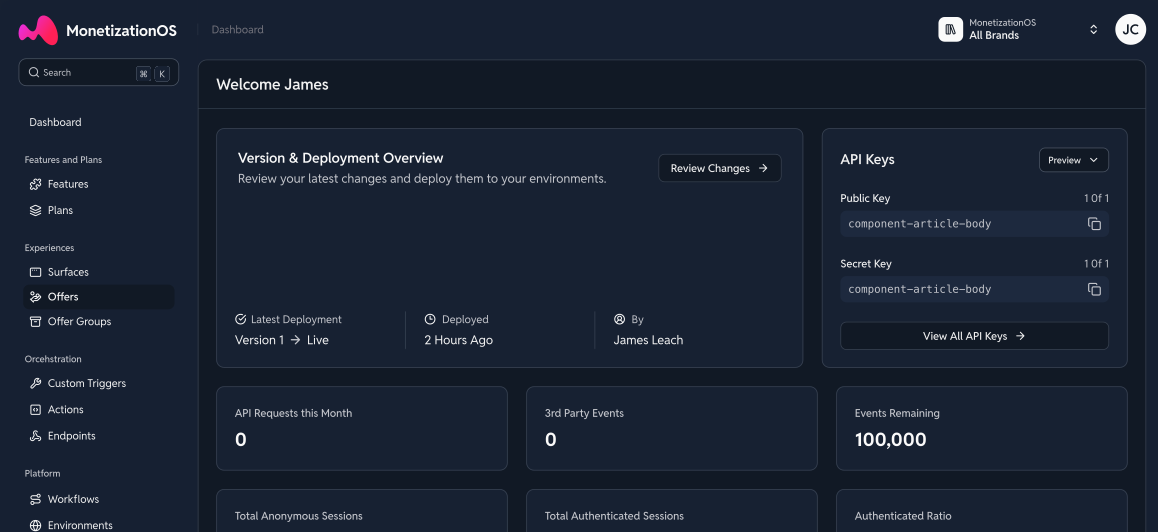
This is exactly the problem we built MonetizationOS to solve. Publishers need decisioning infrastructure that can identify machine readers in real-time, enforce appropriate access rules based on licensing status, meter consumption accurately regardless of traffic type, and do all of this at the CDN edge where it doesn't slow anything down. The decisions happen in sub-50 milliseconds, which means both human and machine readers get instant responses while the publisher maintains complete control over who accesses what under which terms.
The system tracks everything—human pageviews, machine API calls, partial content access, full archive consumption—and attributes it correctly so publishers can demonstrate precise usage metrics when negotiating licensing agreements. When an AI company knows exactly what content it consumed and pays fairly for that usage, it establishes the transparent value exchange that makes ongoing partnerships sustainable.
<div anchor>Building for What's Coming</div>
Building for What's Coming
Machine traffic will only increase. AI systems will only get better at consuming and synthesizing information. The question isn't whether publishers will need infrastructure for machine monetization - it's whether they build it now while they still have negotiating leverage, or scramble to catch up later when the market dynamics have shifted further against them.
We've seen this pattern before in digital publishing. The platforms that adapted early to programmatic advertising, to mobile traffic, to subscriber-first models - they survived and sometimes thrived. The ones that waited, hoping the old models would persist, found themselves negotiating from positions of weakness.
Publishers face a choice. They can continue operating monetization systems designed exclusively for human audiences while machines consume content freely, effectively subsidizing AI development with journalism's dwindling resources. Or they can build infrastructure that recognizes machine consumption, meters it accurately, and captures fair value from this massive invisible audience.
Your biggest reader isn't human. Your revenue model should reflect that reality - and the infrastructure to support it exists now, not in some distant future when the problem becomes impossible to ignore.
-------------
MonetizationOS is edge-native infrastructure that governs and monetises every access request in real time, from human audiences to AI agents. It comes with 1,000,000 free operations per month, no setup fees, and deploys in hours. Get started for free at monetizationos.com