
TL;DR
- Publishing has spent two decades reinventing its commercial model: subscriptions, programmatic, events, licensing, memberships, newsletters and the brand and product extensions that go with them. None of that is going away.
- The conditions in 2026 are pressing on the existing mix in ways that demand more active revenue lines, not the same ones harder. Some are extensions of what publishers already do well, including deeper memberships, premium experiences and first-party data relationships. Some are genuinely new, including direct AI licensing, structured access for machine traffic and agent-tier commercial relationships.
- The publishers in good shape five years from now are the ones running the widest range of active revenue lines deliberately, treating the existing ones as a foundation rather than a ceiling.
For more than two decades, publishing has been one of the most actively reinvented industries in commercial media. The launch of digital editions, the long debate over paywalls, the rise of the metered model, the pivot to subscriptions, the build-out of membership programmes, the events businesses, the licensing arrangements, the brand and product extensions, the affiliate-led commerce sections, the newsletter renaissance: all of it has been hard, active work. Anyone who has sat inside a publishing commercial team for any portion of those years knows the model has never been left to run on its own, and the people running it have not been waiting for things to get easier.
The change happening now is in the range of active revenue lines that the commercial model needs to include. The publishers' willingness to innovate was never the issue, and isn't now. What is shifting is the conditions in which the existing mix has to operate, and those conditions are pressing on publishing in 2026 in ways that the existing model, however well-run, was not built to handle on its own.
A recent gathering of senior leaders at the PPA Festival in London surfaced a set of concerns that no longer feel like separate problems but a single, compounding shift. AI systems are scraping content at scale and giving nothing back. The existing revenue mix, in whatever combination of subscriptions, advertising, programmatic, sponsorship, events and licensing it currently sits in, is being asked to fund the business in conditions it was not designed for. Page-view growth, the metric that has heavily influenced digital publishing strategy for two decades on the advertising side, has lost its strategic meaning in isolation. And the open internet, which publishers have spent a generation defending as a matter of principle, is increasingly being read as a commercial liability when it stands alone, rather than an asset.
The work of the next few years is to widen the mix. Some of the new active revenue lines being built are extensions of what publishers already do well: personalised memberships, premium experiences, structured community products, more sophisticated first-party data relationships. Others are genuinely new, and weren't possible until very recently: AI licensing, structured access for machine traffic, agent-tier commercial relationships, content sales into emerging machine payment standards like x402 and MPP. The publishers in good shape three years from now will be the ones running the widest range of active revenue lines deliberately, treating the existing ones as a foundation rather than a ceiling.
The pressure on the existing mix
The first force pressing on publishers is that the existing revenue mix is being asked to do more work in harder conditions than it was set up for. Subscription growth has hit ceilings on many titles, and the publishers who built strong subscription businesses in the 2015–2022 window are now looking at the next million paying readers as harder to acquire than the first. Programmatic, where it features, has done significant work to keep yield rising even as audience expectations, regulation and platform dynamics have shifted underneath it. Direct advertising has moved in and out of fashion across the cycle. Audience commoditization, opaque supply chains, the slow erosion of referral traffic from search and social, and the structural pressures on display economics across the open exchange are all real, and they are pressing on revenue lines that were already working hard.
Pageview growth has lost its strategic meaning in isolation, on the advertising side at least. Page-view ceilings, set by audience saturation and declining referral traffic, mean that growing the top line by one more headline-driven traffic spike is not the future of any serious publisher's plan. The mood among publishers is not that any one revenue line should go away. It is that no single line, however well it performs, can carry the publishing P&L on its own any more, and the publishers thriving five years from now will be running a wider mix of active revenue lines deliberately rather than reacting to the gaps as they open.
The AI extraction problem
The second force is more recent and more existential. AI companies are systematically training on publisher content and serving derivative answers to users who never visit the publisher's site, see an advert, or enter the lead funnel. The economic asymmetry of this is hard to argue with. Years of investment in original reporting, research, and analysis are being condensed into model weights without compensation, and then re-served to users in ways that bypass the publisher entirely.
The enforcement problem makes the asymmetry worse. Crawler taxonomies multiply faster than detection rules can catch up, user agents can be spoofed, agentic browsers behave like humans, and robots.txt has no enforcement mechanism in the first place. And the AI labs, in private conversations and in public posture, increasingly look like they are waiting publishers out. Every quarter that goes by without meaningful commercial agreements is a quarter in which the publishers' bargaining position erodes further. The first wave of licensing deals (a handful of large publishers, a handful of large AI companies) has not generalised, and the long tail of publishers below those deal sizes is getting nothing.
What this produces is not just a defence problem. It is an opportunity, if it can be converted in time. AI labs need quality content to train on, and increasingly to ground their models against. Agentic browsers need reliable sources of information. Autonomous purchasing agents need structured, machine-payable access to data. None of these buyers existed as a commercial relationship five years ago. All of them are arriving at publisher endpoints today. The question is whether publishers can build the active revenue lines to capture them before someone else does.
The shift toward a more controlled web
The answer increasingly being floated is that the future of access is more controlled than the past. Paywalled-everything has been tried and is not the answer. The kind of control being built now is selective, conditional, and commercially intentional. Some content might be free to humans and priced for machines. Some might be free to subscribers and licensed to AI labs at negotiated rates. Some will sit behind first-party identity that the publisher actually owns and controls. Some will be reserved for community members behind logged-in experiences that produce data the publisher can use to deepen the relationship.
This is more sophisticated than a return to the closed media of the broadcast era. It is a web in which access is a commercial decision made on every request, in real time, by the publisher rather than by an intermediary or by default.
The strategic premise underneath this shift is that the value publishers create needs to be captured at the moment of access, in some commercial form, rather than assumed to be captured automatically by the act of publishing. That charging can take many shapes, and the shape it takes for any given publisher will depend on the audience, the content, and the brand. The move from "publish and rely on whatever monetises the audience that arrives" to "decide who gets what, on what terms, at the moment of the request" is the move that defines this period.
Where the value actually lives now
Inside this shift, an important recognition is taking hold. The value of a publisher in 2026 is not the volume of pageviews it produces. It is the trust it has built, the audience that has chosen it, the editorial voice that nobody else can replicate, the data that comes from a direct relationship with that audience, and the granular control that the publisher has over access to its content.
This is good news for publishers with differentiated brands, niche authority, and active communities. It is harder news for publishers whose business model depended on undifferentiated scale. The active revenue lines now being built across the industry, including deeper subscriptions, memberships, events, community perks, licensing arrangements, paid newsletters, premium experiences, AI licensing deals, and structured access for machine buyers, are all variations on a single theme. They turn the relationship with an audience and the brand they trust into a defensible commercial asset, expressed across as many active revenue lines as the business can sustainably run.
The opportunity here is not always massive scale. Many publishers are realising that even modest paying audiences, well-served and fairly priced, materially improve revenue resilience and retention. A 5% subscription rate against a high-affinity audience can be more durable, and more profitable, than chasing a 50% lift in any single line of the existing model. The economics of attention are giving way to the economics of relationship, and the active revenue lines that monetise relationship at depth are the ones being built now.
The coordination task
The harder question is whether the industry can coordinate fast enough to force the AI market to pay. There is growing appetite for collective action, coalition-building, and industry-wide approaches to scarcity. The premise is that no single publisher has the bargaining position to negotiate with behometh AI labs, but a coordinated body of publishers might. Whether that coordination materialises in time is the open question.
The historical record on industry coordination in publishing is uneven. Each wave of platform negotiation, from search to social to programmatic, has produced moments where the industry talked seriously about collective action but without result. The current wave is different in that the asymmetry is more severe and the time window is more visible. AI labs are training the next generation of models now. The bargaining position to extract value for that training is strongest now, before the models have generalised and before the labs have committed publicly to a sustainable licensing posture.
The publishers moving fastest are not waiting for that coalition to form. They are building licensing infrastructure, negotiating bilateral deals, deploying access controls that distinguish humans from machines, and constructing commercial relationships with AI buyers on their own terms. If a coordinated approach emerges later, the publishers who already have the infrastructure will be the ones who define the shape of it.
Building for the future
The mood across the industry feels far more pragmatic than panicked, and the publishers who are going to be in good shape five years from now are the ones doing four things now:
- They are widening the mix of active revenue lines deliberately and quickly, treating the existing ones as a foundation. Subscriptions, memberships, events, licensing, community products, premium access tiers, AI licensing arrangements, structured access for machine buyers: all of these are being run in parallel rather than chosen between.
- They are investing in the differentiated parts of the brand, the parts that no AI summary can replicate, and treating audience trust as a balance-sheet asset rather than an editorial nice-to-have.
- They are deploying infrastructure that lets them charge differently for different audiences, on every request, in real time. The publishers who can distinguish a paying subscriber from a free reader from a licensed AI partner from an unaffiliated scraper are the ones who can run more than one commercial model at once.
- And they are positioning themselves to act collectively if and when the moment comes, while not betting the business on it arriving in time.
This is the work that matters most. The pressure on the existing revenue mix is real, and the commercial model for modern publishers is at work again. The next decade is about widening that work into areas the existing model was never set up to cover, deliberately and at speed. The publishers who lead that move will set the terms for everyone else.
-------------
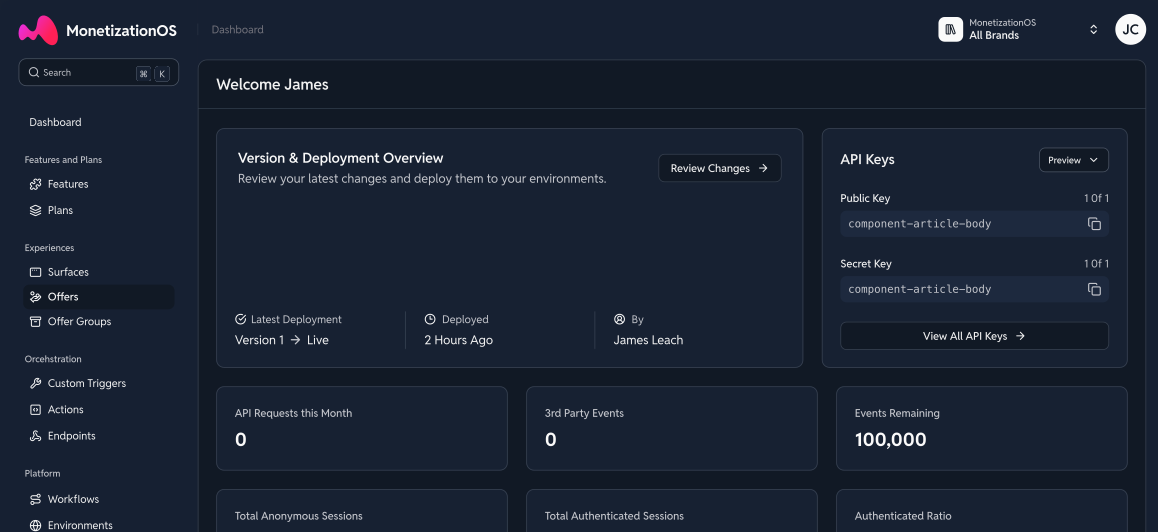
MonetizationOS is edge-native infrastructure that governs and monetises every access request in real time, from human audiences to AI agents. It comes with 1,000,000 free operations per month, no setup fees, and deploys in hours. Get started for free at monetizationos.com