TL;DR
- Publishers with a 6% operating margin are sitting on the same structural problem airlines solved decades ago. Dynamic seat pricing delivers a 5–6% revenue lift for airlines — close to doubling the profit on a 6% margin. Mather Economics found similar results when publishers move to intelligent pricing: one regional publisher saw 24% higher ARPU and 16% revenue growth with less than 1% incremental churn.
- The bottleneck is never strategy. It's infrastructure. When a commercial team wants to test a new price point, a day pass, regional pricing, or an AI licensing tier, each one becomes a multi-week engineering project. Over time, teams stop proposing experiments because experience teaches them the infrastructure can't keep pace. The revenue that never was is invisible, and the gap compounds quietly every quarter.
- The Atlantic built a dynamic paywall in-house and grew from 400,000 to a million subscribers, becoming profitable for the first time in years. The precondition nobody talks about is that they had to build it themselves, because standard publisher stacks can't express that kind of logic.
- Entitlements are the architectural shift that changes this. When access logic is separated from application code, the same feature carries different properties for different audiences: anonymous visitors get five metered articles, subscribers get unlimited, AI agents get metered access under licensing terms. Plans set the dial positions. Commercial teams adjust them without filing tickets.
- Subscriptions remain the most defensible revenue stream in digital media. The question is what sits alongside them. Registered non-converters, casual readers, corporate clients, AI agents, and machine systems each represent a revenue moment you're either equipped to capture or not.
<div anchor>Introduction</div>
An obvious answer
There's a question that rarely gets asked in publisher strategy conversations, because the answer feels so obvious it doesn't seem worth interrogating: what is the product?
Most smart people would say the content. You produce journalism, analysis, reporting, and you monetise it with a subscription. The content is the product, the subscription is how you charge for it, and everything else (the pricing page, the paywall logic, the metered access rules) is plumbing. That mental model has served the industry well for two decades.
But consider what a visitor actually experiences when they arrive at your site. They don't experience "content" in the abstract. They experience an access decision. Can I read this? How much does it cost? Does the price match how I want to consume it? Is the exchange fair enough to bring me back? That decision, made in milliseconds, determines whether you capture revenue or lose the visitor. The content is the asset that makes everything valuable. The access decision is the product.
What if the gap between what publishers could be earning and their current revenue has less to do with the quality of the journalism and more to do with the sophistication of that access decision and the levers it allows the business to pull?
<div anchor>What the airline industry figured out</div>
What the airline industry figured out
INMA reported that the median operating profit margin for news media companies is 6%. Airlines operate in a similar range, low single digits, with comparable exposure to volatile demand and fixed infrastructure costs. But airlines solved a version of this problem many years ago, and they are better off for it.
Every seat on a flight is principally the same physical product. What varies is the access and entitlements: when you book, how flexible the ticket is, which class, which route, whether you're a loyalty member. An airline doesn't set one price for a seat and hope for the best. It runs thousands of micro-experiments continuously, adjusting prices based on demand, timing, route, and customer segment, and the revenue implications are enormous. Dynamic seat pricing typically delivers a 5-6% lift in revenue for airlines. On a 6% operating margin, that's close to doubling the profit.
Mather Economics, which has worked with thousands of publishers on pricing strategy, has found similar results when publishers move to intelligent pricing. In one case, a large regional publisher with hundreds of thousands of digital subscribers saw 24% higher average revenue per user and 16% top-line revenue growth by replacing static step-up pricing with behavioural pricing models. Incremental churn was less than 1%.
The question is why so few publishers have made this shift. And the answer, almost always, turns out to be infrastructure and process.
<div anchor>When infrastructure caps strategy</div>
When infrastructure caps strategy
The Atlantic provides an interesting case study here. In 2019, the magazine launched its paywall with roughly 400,000 subscribers. By 2024 they'd reached a million, and for the first time in years, became profitable. A key part of how they got there was building a "smart meter" in-house: a dynamic paywall that adjusts both who sees the paywall and what price they're offered, based on behavioural signals. Readers who browse across verticals see different offers than single-topic visitors. Prices range from $60 to $100 depending on propensity to convert. Renewal pricing adjusts based on likelihood to churn. When the publication needs to hit advertising impression targets, the wall loosens to let more unsubscribed readers through.
The Atlantic's CEO, Nick Thompson, described it as finding the optimal price for the publication. And while dynamic pricing may not be right for all it serves as an interesting case for innovation, based on access control alone. But what's also easy to miss in that story is the precondition: the Atlantic had to build this system themselves. Most publisher technology stacks can't express or experiment with this kind of logic, because they were designed around a simpler assumption of reality.
Think about what happens in most organisations when the commercial team has an idea. A new price point for a high-intent segment. A day pass for readers who won't commit to a subscription but would pay for 24 hours of access. Regional pricing for a market where the standard rate doesn't match local purchasing power. A bundled offer across two brands. Metered access for an AI agent querying the archive under a licensing agreement. Each of these is a real commercial opportunity. Each requires the infrastructure to express a permission that doesn't fit the standard subscription model. And in most publisher stacks, each one often becomes a multi-week engineering project: write it up, get buy-in, file a ticket, wait for a sprint, go through staging and release.
The compounding cost is worse than the delay on any individual project. Over time cadence slows, commercial teams stop proposing more creative experiments or write off genuinely innovative ideas, because experience has taught them the infrastructure can't keep pace. Meanwhile, engineering and product teams are often desperate to say yes, but can’t because they have to be the real arbiters of the infrastructure realities. The monetisation strategy therefore calcifies around whatever access models, ideas and experiments were technically feasible when the system and stack was configured. The gap between possible revenue and actual revenue grows wider each quarter, and nobody quite notices because the leak is almost invisible. It is the revenue that never was. The idea that wasn’t possible.
<div anchor>The Blendle question</div>
The Blendle question (and why it keeps coming back)
Micropayments have failed in publishing roughly once a decade since the 1990s. Digicash, Clickshare, Bitpass, and then Blendle, which launched in the Netherlands in 2014 as "the iTunes for journalism" with investment from the New York Times and Axel Springer. Blendle's founder Alexander Klöpping put the pitch simply: his friends had never paid for music or movies until Spotify and Netflix came along. Blendle would do the same for journalism.
It worked, kind of. Fewer than one in ten users asked for refunds. New readers were paying for journalism for the first time. But the model struggled to reach profitability, partly because of what computer scientist Nick Szabo identified back in 1996 as "mental transaction cost": the cognitive overhead of deciding whether each individual article is worth paying for.
More recently, the Toronto Star launched a pay-as-you-go model. The Washington Post has experimented with similar approaches. The Winnipeg Free Press sold articles for 27 Canadian cents each and found that 15% of micropayment users eventually became full subscribers. Other publishers have had quiet successes with article gifting to bypass friction.
The pattern is consistent: the logic of micropayments makes intuitive sense. As Rory Sutherland, vice-chairman of Ogilvy, has observed, people hate paying for things they don't want, bundled with the things they do want. The individual commercial experiments keep delivering interesting results - but they keep failing at scale, and the usual explanation is that micropayments are simply a bad model. However, can new innovations such as 402 and agentic payments start to change this?
What if the real problem is infrastructure? What if micropayments, day passes, dynamic pricing, regional pricing, usage-based AI licensing, and every other "alternative" monetisation model keep failing not because the commercial logic is wrong, but because the infrastructure required to run them at the speed and granularity the market demands doesn't exist in most publisher stacks? It is early days, but is your company ready if it turns out to be different this time?
<div anchor>Entitlements as the atomic unit</div>
Entitlements as the atomic unit
There's a more useful way to think about all of this. Every access decision a publisher makes, whether it's "this subscriber gets unlimited articles" or "this AI agent gets 100 requests per day under a licensing agreement," reduces to the same thing: a permission that defines what a specific visitor can do with specific content at a specific moment. In software, this is called an entitlement.
What makes entitlements interesting for publishers isn't the concept itself (it's borrowed from SaaS, where it's been standard for years). It's what happens when you make them the foundation of your monetisation infrastructure rather than an afterthought.
A single feature like "articles" can carry multiple properties simultaneously. A metered property governs how many a visitor can read per month. A boolean controls whether premium longform is included. A string defines the content quality tier. Each property can be set differently across audience segments, so an anonymous visitor arriving from social media gets five metered articles with no premium access, a registered user gets ten with selected premium pieces, a paying subscriber gets unlimited reads at the highest tier, and an authenticated AI agent gets metered access with a per-request limit and a content flag governing what can be used for inference versus what requires a full licensing agreement.
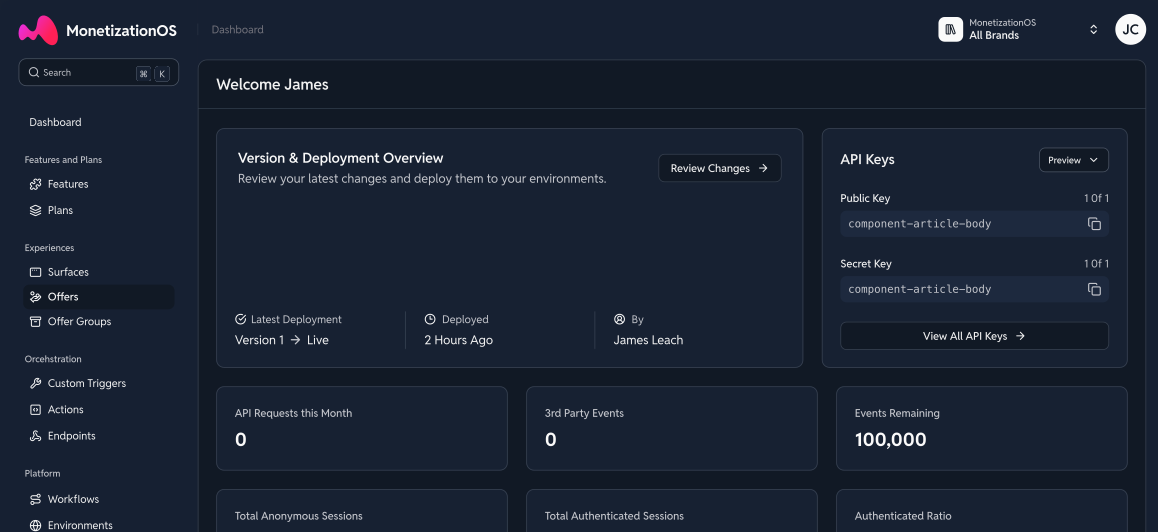
The feature stays the same throughout. The properties are the dials. Plans set the dial positions for each audience. And when you want to test a new price, launch a regional offer, or create an access tier for a visitor type that didn't exist last quarter, you're adjusting entitlements, not rewriting code or filing engineering tickets.
This is the separation that changes the speed at which commercial teams can operate. It's also why The Atlantic had to build their system in-house, and why Mather Economics can show such dramatic results when publishers adopt intelligent pricing: once the infrastructure can express granular, context-sensitive access decisions, the commercial strategy expands to fill the space.
<div anchor>Where is your organisation on this spectrum?</div>
Where is your organisation on this spectrum?
The strongest argument against all of this is that subscriptions work. The New York Times has over 11 million paying subscribers. The Atlantic went from broke to profitable in three years. The FT has built a premium digital business with world-class retention. Most successful content and IP companies make the far majority of their money from this model. Why complicate success?
That argument deserves honest engagement, because it's right: subscriptions are the most predictable and defensible revenue stream in digital media and beyond. The publishers who committed early were vindicated. Nothing in this piece suggests abandoning them.
The question is what sits alongside them. Human subscribers will remain the core revenue relationship for most publishers, and a key part of the argument is how we maximise that opportunity too (human + agent hybrid subscriptions, anyone?). The visitor types arriving at publisher sites are expanding and diversifying, and each represents a commercial relationship that existing subscription infrastructure alone can't serve. Registered users who haven't converted. Anonymous browsers who'd pay for a single piece but won't commit to a recurring charge. Corporate clients who need institutional access. Human users that want to feel part of a community. AI agents consuming content on behalf of humans. Machine systems requesting access under licensing agreements or paying for usage in inference.
Each of those is an entitlement decision. A revenue moment you're either set up for capturing or missing out on. And ready or not, they might find you soon. The flexibility and composability of your monetization infrastructure will determine the outcome when they do.
----
This is the second in a six-part series on what rebuilding publisher revenue from scratch actually looks like. Next up: Your stack is slower than your team.
MonetizationOS is edge-native infrastructure that governs and monetises every access request in real time, from human audiences to AI agents. It comes with 1,000,000 free operations per month, no setup fees, and deploys in hours. Get started for free at monetizationos.com