
TL;DR
- The paywall answered one question for twenty years: should this person see this page? That question assumed the visitor was human. In 2025, automated traffic overtook human traffic for the first time, and most paywall infrastructure has no framework for the majority of visitors now arriving.
- The human side has its own gaps. Ninety-one percent of metropolitan publisher visitors read five or fewer articles a month. The subscription model serves loyal readers well and leaves everyone else unmonetised: the casual reader, the price-sensitive reader in a different market, the person who would pay for one article but not a recurring charge.
- The counterargument is honest: subscriptions built the New York Times to 11 million paying subscribers and gave digital publishing a viable business model. The problem isn't that subscriptions are wrong. It's that they serve one segment brilliantly and leave the rest of the demand curve untouched.
- That unmonetised rest now includes AI companies scraping archives, agents accessing content on behalf of human users, and a licensing market forming in real time. In 2025, the Washington Post, Guardian, Schibsted and dozens of others signed content deals with OpenAI, Google, Microsoft and Meta. A publisher whose infrastructure can only answer one binary question has no mechanism to participate.
- The shift from paywall to entitlement engine is not a version upgrade. It is a different answer to a wider question: who is asking, through what channel, under what commercial arrangement, and what should they pay for it.
<div anchor>Introduction</div>
Should this person see this page?
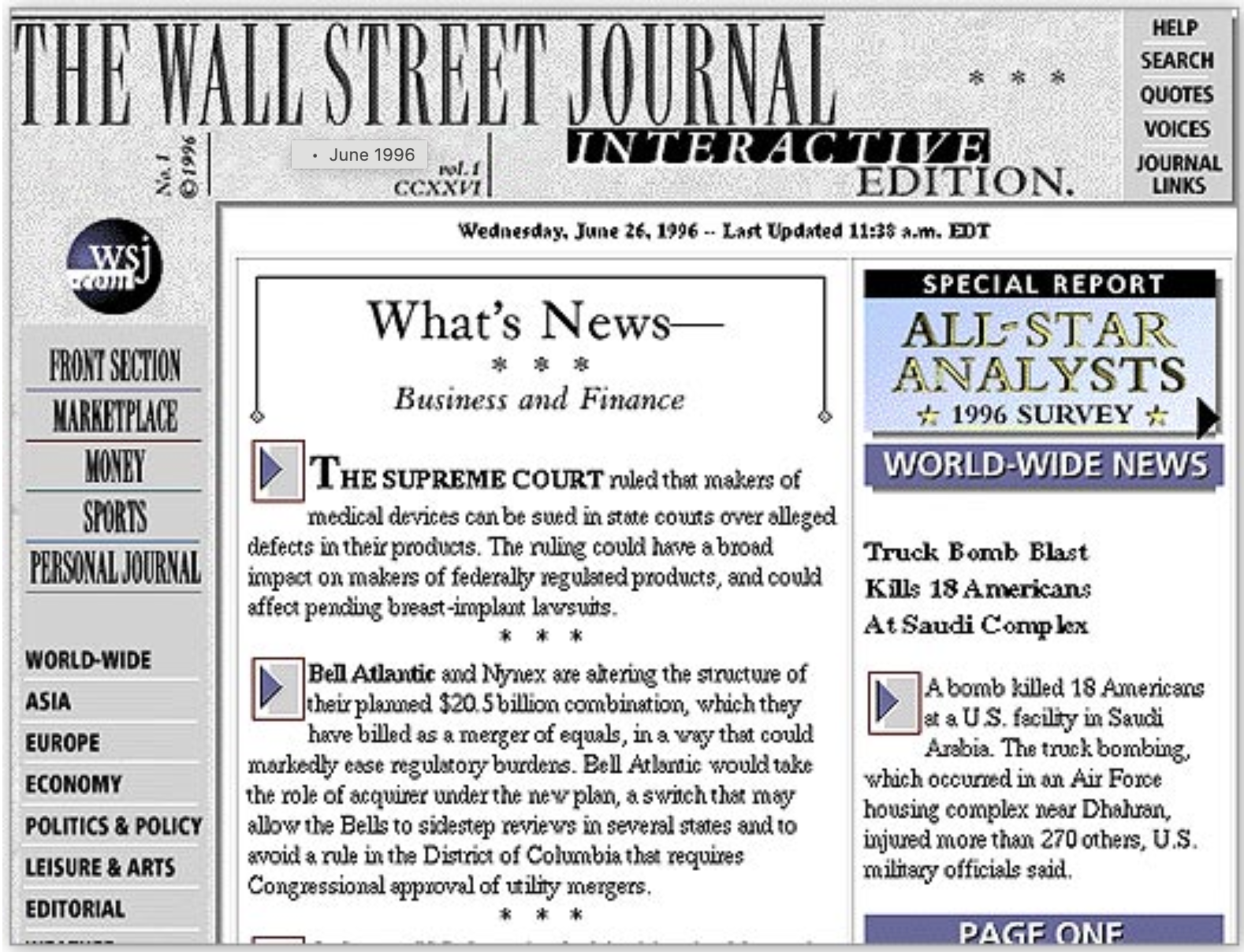
On April 29, 1996, the Wall Street Journal published its full edition online. By January 1997 it had added a hard paywall: $49.95 a year for non-print subscribers, $29 for existing print readers. Within eighteen months, it had 200,000 paying digital subscribers, two-thirds of them online-only. Most of the industry thought they were mad. Content on the web was supposed to be free.
Ten years later, the Financial Times tried something different. Instead of all-or-nothing, the FT introduced a metered model: read a handful of articles free, register for a few more, then pay. In 2011, the New York Times adopted a similar approach and within a few years had built one of the largest digital subscription businesses in journalism. The playbook was set.
Here's what all of these models shared: they were answering a single question. Should this person see this page? If yes, serve the content. If not, show a subscription prompt. The entire monetisation model sat on that one decision, and for the better part of twenty years it worked well enough to build viable businesses. Publishers who made the bet on charging were vindicated as advertising revenue proved insufficient on its own. That instinct was right.
But sit with this for a moment: what happens when that single question stops covering the reality of who's actually arriving at your site?
<div anchor>Who's visiting now?</div>
Who's visiting now?
The 2025 Imperva Bad Bot Report found that automated traffic surpassed human activity on the web for the first time in a decade, accounting for 51% of all internet traffic. Akamai's own research found that 63% of AI bot triggers in the digital media sector came from the publishing segment specifically.
These visitors don't scroll, they don't subscribe, click ads, or convert. They consume content at scale and move on, giving nothing in return. And the economic implications go further than serving infrastructure costs for zero-revenue traffic. A landmark study by the BBC and the European Broadcasting Union, involving 22 public service broadcasters across 18 countries, found that 45% of AI assistant responses to news queries contained at least one significant issue. Sourcing problems appeared in nearly a third of all responses. One in five had major accuracy failures, including fabricated details and outdated information.
Verified journalism goes in. Distorted summaries come out. The publisher bears the reputational risk. The AI company captures the user relationship.
Most paywall infrastructure has no framework for this traffic at all. The question "should this person see this page?", by its nature assumes a person. When the visitor is a machine, the question doesn't even get asked.
<div anchor>Who's leaving without paying (and why?)</div>
Who's leaving without paying (and why)?
But the challenges don't solely arise from bot traffic, so let's consider human audiences. A survey of 15 metropolitan publishers found that 91% of their website visitors viewed five or fewer articles within thirty days, and 68% viewed just one. These aren't people who refuse to pay for journalism, they are people whose consumption pattern doesn't match the product being offered. An annual subscription for a single article per month is a hard sell, no matter how polished the paywall copy.
Let us also think about the reader in São Paulo or Lagos who would pay something for original reporting, but not the price calibrated for London or New York. Or the reader who would happily pay for the one piece they're looking at right now, but won't commit to a recurring charge they'll forget to cancel.
Everyone is becoming more aware of the subscriptions they pay for and the demand curve has become far more complex than the infrastructure serving it.
The question worth asking is: how much revenue disappears not because people don't value the content, but because the only option available doesn't match how they want to consume it?
Spotify is an interesting comparison. They made a bet that looks counterintuitive at first: all the music is technically free, with ads. But the missing features (offline mode, playlists, sound quality) are compelling enough that Spotify converts roughly 40% of its free users to paid subscribers, against an industry average of 2-5% for freemium products. The habit forms first. The conversion follows.
Most publisher stacks can't run that experiment even if they wanted to, because the infrastructure assumes a binary: subscriber or not. The question isn't whether publishers are smart enough to try dynamic access models. It's whether their technology lets them.
<div anchor>The strongest argument for the status quo</div>
The strongest argument for the status quo
The counterargument deserves honest engagement, because it's a good one.
Netflix built a business worth hundreds of billions on simple subscriptions. The New York Times has over 11 million paying subscribers. The FT has built a premium digital business with consistently high retention. The subscription model clearly works at scale for publishers who execute it well, and the discipline of earning recurring revenue from a loyal audience is enormously valuable. Why complicate what's already working?
The answer isn't that subscriptions are wrong. They're one of the best things that happened to digital publishing. The answer is that subscriptions serve one segment of the audience brilliantly, and leave the rest of the demand curve unmonetised. When that "rest" included mostly human visitors who didn't want to pay, the trade-off was acceptable. When it now includes AI companies scraping your archive, agents accessing your content on behalf of human users, and a licensing market forming in real time, the trade-off looks different.
2025 saw an explosion of AI content licensing deals: the Washington Post, the Guardian, the New York Times, Schibsted, Condé Nast, and dozens more signed agreements with OpenAI, Google, Microsoft, Meta, and others. The Really Simple Licensing (RSL) Collective launched with over 50 publishers. People Inc. CEO Neil Vogel described the emerging market as offering both "all you can eat" lump sum deals and "à la carte" pay-per-use models.
A publisher whose infrastructure can only answer "should this person see this page?" has no mechanism to participate in this market. A casual reader, a loyal subscriber, a bot scraping your archive at three in the morning, an AI company that wants to license your back catalogue, and a human reading your journalism through an AI assistant are five different relationships with different economics. They require different access decisions, different commercial terms, and different infrastructure.
<div anchor>Will AI companies actually pay?</div>
Will AI companies actually pay?
There's a paper in Nature from 2024 (Shumailov et al.) on what happens when AI systems train on AI-generated content rather than human-originated material. The researchers found that indiscriminate training on model-generated data causes what they call "model collapse": the tails of the original content distribution disappear first, then diversity degrades recursively until the output bears little resemblance to the original data.
The implication for publishers is significant. If AI loses access to original reporting, expert analysis, and the work that actually costs something to produce, the models get worse. Which means the value of original content isn't just a publishing-industry talking point. It's a structural dependency for the AI ecosystem as a whole.
The conversation worth having isn't whether to charge for original content (that question is settled). It's how to price something whose value as an input to AI systems is only becoming visible now, and whether your infrastructure lets you participate in that negotiation.
<div anchor>From paywall to entitlement engine</div>
From paywall to entitlement engine
Airlines have been running a quiet experiment for forty years that most other industries haven't caught up with. The seat itself doesn't change. The plane doesn't change. But who's buying, when, for what purpose, and with what flexibility all change the price, the terms, and the relationship. Revenue management exists because different buyers value the same capacity differently, and leaving that asymmetry unexploited is a commercial choice, not a technical inevitability. Publishers are sitting on an identical asymmetry right now, and most of their infrastructure is still selling one ticket type.
The paywall did its job. It answered the question that mattered for twenty years: should this person see this page? And charging for original content was the right instinct, vindicated by the collapse of the advertising model that many publishers were depending on as an alternative. But the visitors showing up at the gate have changed considerably. A publisher's access infrastructure now needs to distinguish between a subscriber renewing, a first-time reader weighing up a trial, a verified licensing partner, an unlicensed crawler, and an AI agent making requests on behalf of a user who'll never see the original page. No paywall was designed to handle that range, because those visitors didn't exist when paywalls were designed.
What the infrastructure actually needs to do is evaluate each access request against the full context of who is asking, through what channel, under what commercial arrangement, and return the right decision in milliseconds, before content is served. The same system, governing human subscribers and AI agents through the same commercial logic, with the same level of control and visibility. The framing shift that matters here is treating machine traffic not as a security problem to be blocked but as a commercial relationship to be governed. There is a licensing market forming around AI training and retrieval right now. Publishers who have the infrastructure to participate in it will shape its terms. Publishers who don't will watch it form from the outside.
That's an entitlement engine, and the architecture is genuinely different from a paywall - not a version upgrade, but a different answer to a wider question.
The appetite AI companies have shown for publisher content is itself evidence of what original journalism and analysis is worth as an input to the systems now reshaping how information is distributed. The principle that original content should be paid for has never been more defensible. The question is whether the infrastructure can act on it across every kind of visitor, not just the ones who pay by direct debit.
----
This is the first in a six-part series on what rebuilding publisher revenue from scratch actually looks like. Next up: Access Control Is The Real Product
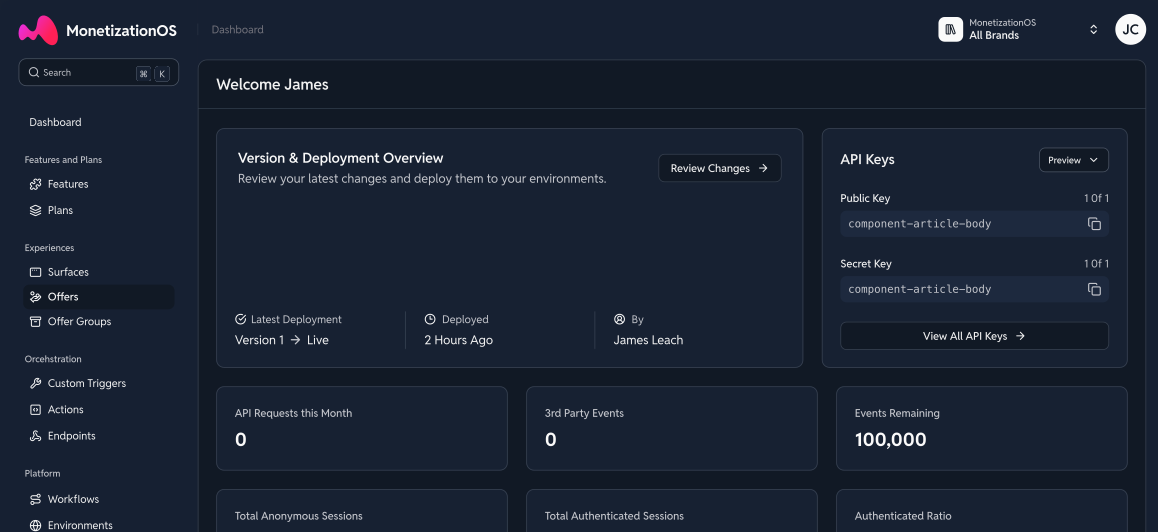
MonetizationOS is edge-native infrastructure that governs and monetises every access request in real time, from human audiences to AI agents. It comes with 1,000,000 free operations per month, no setup fees, and deploys in hours. Get started for free at monetizationos.com