Billing systems record who paid. They can’t decide what each visitor is allowed to reach - because many visitors, from AI agents to crawlers, never make a payment for billing to see.
That decision is a different job, handled by a different layer: access.
Move to a modern billing platform and a whole category of pain disappears. Stripe is the obvious example. It moves the money, handles tax and dunning, retries failed cards, and with Entitlements it will even map features to plans and tell your app what a paying customer is allowed to use. If your audience is human and your unit of value is a monthly plan, the setup is simpler than it was three years ago.
So you would be forgiven for thinking the monetization stack is handled. But then a question arrives that billing was never built to answer.
Who is this request actually from?
A request comes in for a premium article. Billing does not see that request - it does not inspect incoming traffic. An identity layer has to recognize the request first, then query billing for the commercial state behind it. And even once it does, knowing whether a payment exists cannot tell you which of these you are dealing with:
- A subscriber, reading on their laptop.
- That subscriber’s AI assistant, fetching the piece on their behalf.
- A lapsed reader whose card failed in March.
- An anonymous visitor from search.
- A training crawler working through your archive.
- A licensed bot that has agreed terms.
Each is a different commercial relationship, and each should get a different answer about what it can reach and on what terms. Most of them never touch a checkout. More than half of web traffic is now automated - 53% in 2025, up from 51% in 2024, in the traffic Imperva measured for its 2026 Bad Bot Report - and a machine fetching your content will never make a payment for billing to record.
The decision about what it gets has to be made anyway, on every request.
This is an access problem, and it is a responsibility that often falls between product, engineering, revenue and security teams.
Why payment isn't the same as enforcement
A payment may establish the commercial state behind an entitlement, but it does not enforce access.
If full content reaches the browser before the access decision is applied, a scraper may be able to retrieve it directly from the response or by executing the page. Enforcement has to happen earlier: at the edge, on every request, before content is served.
Billing records what was charged, at the end of the journey. The access decision happens at the start of it, governing what each visitor is allowed to do before anything is served.
Access is four jobs, not one
Deciding what a visitor gets breaks into four distinct jobs:
- Identity. Who or what is asking - a subscriber, an agent acting for one, an anonymous visitor, a crawler.
- Commercial state. What that party has purchased or agreed - an active plan, a lapsed one, a licensing deal, or nothing at all.
- Policy. What this requester may access, given the first two.
- Enforcement. Applying that decision on every request, before content is returned.
Billing supplies part of the commercial state, including subscriptions and payment status. Other rights may come from licensing, CRM or contract systems.
None of them establishes identity, sets policy or enforces access.
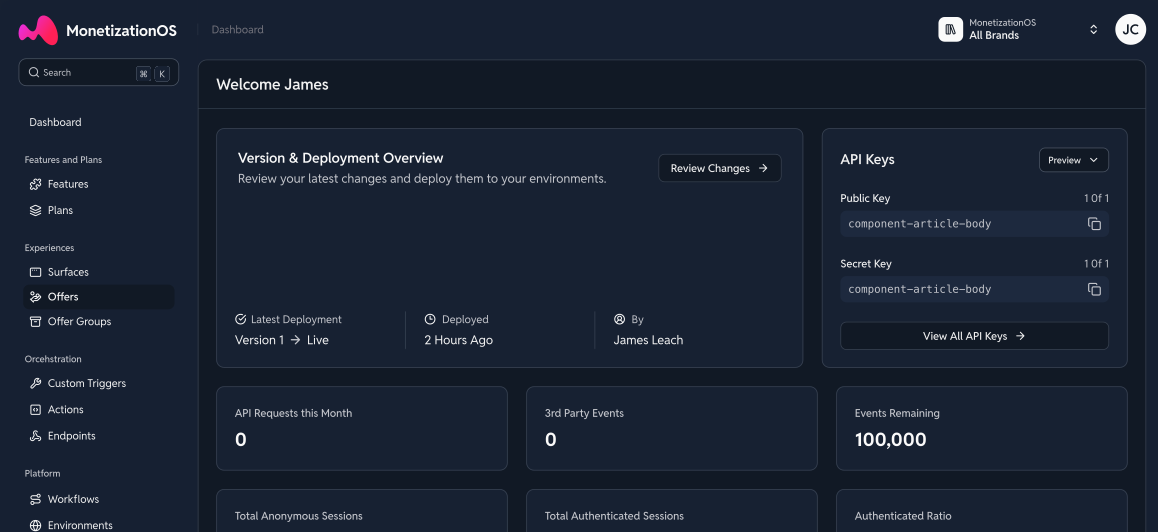
MonetizationOS unifies policy and enforcement, and consumes the signals from identity and commercial state to make one decision per request. It works above the billing you already run, not instead of it.
Trace one premium-content request from arrival to response. Which system identifies the requester, which selects the rule, and where is it enforced? Any gap between those three points is where access leaks.
Stripe owns payments. MOS owns access.