
Every digital business makes thousands of commercial decisions a day.
- Who sees a paywall.
- Who gets the discount.
- Who lands on the premium offer.
- Who gets the soft prompt.
We tend to think of these as our decisions, made on our terms, expressing our strategy.
For most businesses, they aren't. They're being made on the user's device, in conditions you didn't choose and can't see.
Here's what I mean. A lot of commercial logic runs client-side, in the browser, after the page has started loading. Which means the experience a user actually gets depends on things that have nothing to do with your strategy.
- Whether they're running an ad blocker.
- Whether they've turned off JavaScript.
- Which browser they're on, and how old it is.
- How fast their connection is, and how much patience they have before they give up and move on.
You designed one experience. They received another, shaped by their setup rather than your intent.
Some of this is innocent. A reader on a patchy train connection gets a different experience from the same reader at their desk - not because you decided they should, but because their connection made the decision for you.
Some of it isn't. We'd like to believe users aren't actively trying to get around the paywall, or that it's too fiddly for most people to bother. That's no longer true. Disabling JavaScript, running an extension, using reader mode: the methods are well known and a search away.
If your commercial logic only works when the user cooperates, you've built a strategy that anyone can opt out of.
The deeper problem is what this does to your numbers. If the experience people receive is partly a function of their browser, their extensions, and their connection, then your conversion data is partly measuring browser, extensions, and connection.
You think you're testing a pricing strategy. You're also, invisibly, testing your users' setups. That's not a foundation you want to make commercial decisions on.
So what's the alternative? The short version: make the decision earlier, somewhere you control, before any of those variables get a say.
This is what people mean by "the edge." Rather than waiting for the page to load on the user's device and then deciding what to show, the decision is made upstream, on infrastructure between your content and the user, in a few milliseconds, before their browser or their extensions or their connection can interfere.
By the time anything reaches the device, the decision is already made. The right experience shows up because you decided it should, not because the conditions happened to allow it.
For commercial teams, that changes what you're actually in control of.
- Your pricing logic runs every time, not just when the setup cooperates.
- Your offer strategy executes as designed.
- Your data measures your decisions, because the noise of the user's environment has been taken out of the equation.
You can run experiments knowing the result reflects the thing you changed, not the kit the user happened to be on.
This matters most for your human audience, because that's where the nuance lives: the returning reader, the lapsed subscriber, the first-time visitor, each deserving a different experience, each currently at the mercy of their own device.
There's a second group it affects too, and the numbers there are climbing fast.
The moment a decision happens client-side, it assumes there's a client: a browser, rendering a page, running your logic. Bots, crawlers, and AI agents don't work that way. They don't render your page or wait for your scripts. They take the content and leave.
Anything you were planning to do at the device, gating it, pricing it, governing access to it, never happens, because there's no device to do it on. Client-side logic doesn't just degrade for humans with the wrong setup. For machine traffic, it often doesn't run at all.
The fastest-growing share of traffic to most sites is walking straight past commercial logic that was never built to catch it.
Edge decisioning closes both gaps at once, because the decision sits in the same place for everyone. A human running an ad blocker and an AI crawler with no browser hit the same decision point, made on infrastructure you control, before either of them can route around it.
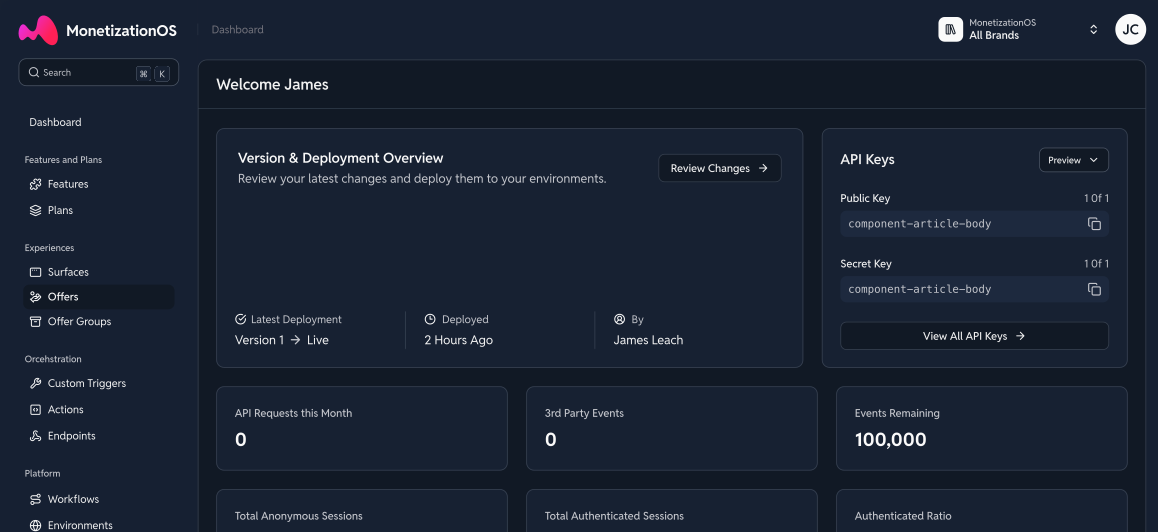
This is the conviction MonetizationOS is built on. Access and monetization decisions belong upstream, made once, applied to every kind of user, before the conditions you can't control get to rewrite them. Your commercial strategy should be something you execute, not something you hope survives the journey to someone else's screen.
Stop outsourcing the decisions that matter most to the device on the other end. Make them where you can still see them.
---------------
MonetizationOS is edge-native infrastructure that governs and monetizes every access request in real time, from human audiences to AI agents. Get started for free at monetizationos.com