
I’ve spent more than a decade in audience monetization, and the same pattern shows up almost everywhere: the people who own the revenue can’t change how it’s earned without asking someone else.
A pricing test waits in the engineering queue. A new access rule needs a ticket. And the fastest-growing part of the audience - machines - gets handled by the security team, who can only block it or allow it.
Underneath all of it is one decision: who gets to make commercial calls. In most stacks, it isn’t the commercial team.
Monetization is a commercial decision
Who gets access, on what terms, at what price - those are commercial questions. They belong to the people who own the revenue, not the people who maintain the infrastructure.
A paywall doesn’t see it that way. It’s a single outcome - show the wall, take the subscription.
But subscription is one of many ways content earns: metering, registration, gifting, B2B and group access, pay-per-use, licensing, pricing a request from a machine. A wall is just one of them.
A single wall, a subscription, a registered user: that’s a narrow model of who actually shows up. Enterprise accounts, researchers, casual visitors, gifted readers, and now machines all need different terms. The test for any tool is whether it can hold all of them, or whether you’ll be working around its edges within a year.
And it isn’t only what the tool allows - it’s who has to touch it. If changing a price or launching an offer means engineering, every time, then your monetization moves at the speed of the engineering queue.
The commercial team has the ideas, and the ability to ship them lives in someone else’s backlog.
Plenty of tools were sold on removing that dependency, then reintroduced it the moment anyone wanted to do something non-standard.
If your commercial team can’t change a pricing rule without raising a ticket, that’s not a workflow problem. It’s a structural one, and the tool is the cause.
Machine traffic is where this breaks in the open
Most paywalls were built for a human making a binary choice, and they enforce it in the browser - which is exactly why they’re invisible to a scraper and no barrier to an AI agent.
The moment you start planning for what’s coming - governing AI crawlers, licensing content to AI on your terms, telling a subscriber’s own agent apart from a training bot - you’ve stopped shopping for a paywall. You’re shopping for an access layer.
The part most conversations miss is that machine monetization isn’t only a technical capability, it’s an operating one.
In most organizations, the only place machine traffic gets touched is the security layer, where the levers are block or allow and the team running it has no commercial brief. So it gets handled as a threat, and never as revenue.
That won’t change while the machine decision sits in a different system from everything else you charge for.
Where the access decision should live
Machine monetization doesn’t happen by accident. It happens when the people with a commercial mandate can set terms, price access, and manage machine visitors the same way they manage human ones - from the same system, with the same control.
Leave that decision in the security layer and it stays a threat rather than a line of revenue.
Very few of the options I’ve looked at can do that. They were built before the question existed.
So the real question underneath any monetization tool isn’t its feature list - it’s whether the people who own the commercial outcome can actually operate it, for every visitor who arrives, human or machine.
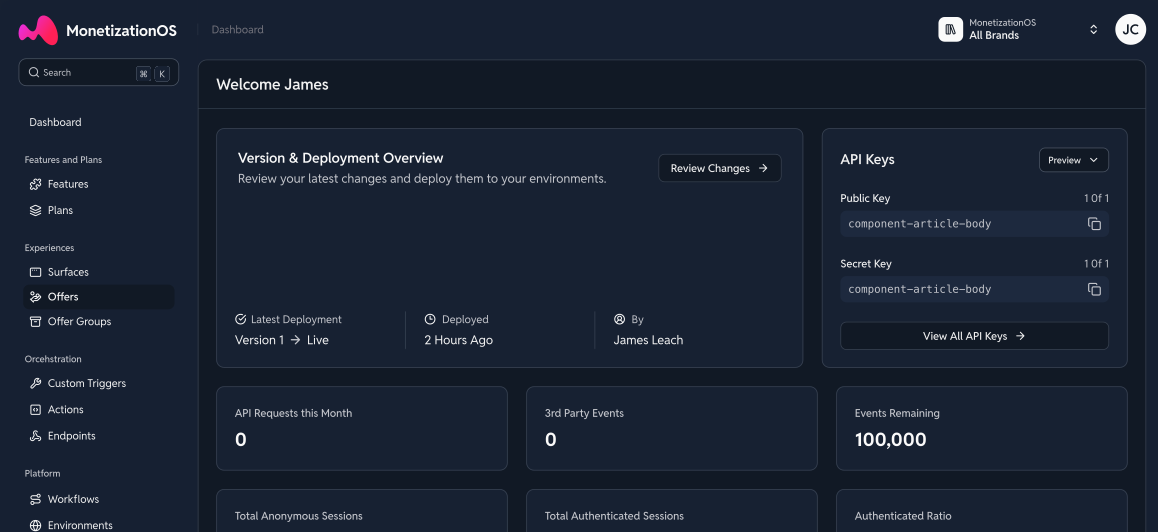
That’s what we built MonetizationOS for: one layer that governs access for every visitor, human or machine, operated by the people who own the commercial outcome.
If you’re weighing specific platforms - suites, specialist walls, and where an access layer fits - that’s a buyer’s-guide question, which you can read more about in How to Choose a Paywall Platform (When Half Your Traffic Isn’t Human).
But before you compare features, the structural question is the one to settle first: who gets to change a pricing rule?