
TLDR
- AI has made decent educational content effectively free, which has broken the economics of paid learning.
- Content is a feature; progress is the product.
- The winning model is skill access: priced per milestone, metered against the services that move people forward, and tied to verified outcomes rather than logins.
From Subscriptions to Skill Access: Rethinking the Economics of Learning
<div anchor>Introduction</div>
The floor has fallen out from under paid educational content. Generative AI has made decent explanations cheap and instant. Every “how do I…” now has a competent, contextual answer for free. Subscription catalogs look full, but perceived value has collapsed because the marginal cost of another lesson is now near zero. If your model is “pay for access to content,” you’re selling what the market can already get without you.
It isn’t quality that’s failing. It’s distance. Learners and employers pay to get from intent to competence with minimal detours. When the distance is unknown, the risk sits with the buyer. That’s why “all-you-can-learn” subscriptions feel unfair: the provider gets paid whether the learner progresses or not. Completion rates for open courses remain commonly cited in the single digits. CFOs are cutting seat licenses that don’t map to on-the-job outcomes because the waste is obvious. The economics are punishing anyone who charges for inputs instead of progress.
<div anchor>Content isn’t the product</div>
Content isn’t the product
Three structural shifts explain the squeeze.
1. Supply shock: AI collapsed the cost of good-enough explanations and exercises. This is a classic abundance shock. When the supply curve moves right, clearing price falls. Content that once justified a paywall no longer does.
2. Time scarcity: The limiting factor is attention, not material. Learners need to decide what to do next, stay on track, and get feedback when stuck. Decision distance—the gap between where they are and the next effective action - kills momentum and converts time into churn.
3. Outcome accountability: Buyers - individuals and employers - are shifting from access to evidence. They want demonstrations of skill acquisition: assessments that predict job performance, proficiency gains tied to time-in-role, or verified milestones like “passed the certification.” Without outcome observability, willingness to pay drops.
Put simply, content is a feature. Progress is the product. The unit of value in learning is not a video or a course; it’s a reduction in time-to-proficiency for a specific skill. That is what justifies payment, because it trades money for reduced latency, reduced uncertainty, and reduced waste.
The logic behind subscriptions was sound in a scarcity era: bundle content, lower per-unit price, maximize usage. The logic is still sound; it’s just running in the wrong place. In today’s environment, bundling should aggregate the services that move someone forward—adaptive paths, timely feedback, practice orchestration, social accountability - not PDFs and videos.
<div anchor>Price the path, not the library</div>
Mechanism: price the path, not the library
Selling progress requires two things: metering and outcomes. You need to observe where a learner is, adapt what they see next, and meter charges to the work that actually advances them.
- Define progress units: Break competencies into measurable milestones (e.g., “SQL Joins at 80% mastery,” “Passed AZ-104”). Align each milestone with assessments that have predictive validity for the job or certification.
- Instrument the journey: Track time-on-task, attempts, mastery probabilities, and stuck states. This creates an observable progress function: inputs (time, attempts) to outputs (proficiency gains).
- Adapt in real time: Use the data to deliver the minimum effective path - next drill, targeted explanation, human intervention at the right moment. The goal is to remove decision distance and keep latency to competence low.
- Meter access to engagement: Price against the parts of the experience that consume scarce resources and create progress - coaching calls, AI tutor tokens, proctored assessments, project reviews - rather than the static content surface. You are selling “skill access”: guaranteed access to the right help at the right moment.
- Tie payment to outcomes: Trigger charges on milestone verification, not on login. Offer risk-sharing: “no progress, no charge,” credits for stalls, bonuses when learners beat time-to-proficiency targets. Fairness becomes systemic - buyers pay when value is delivered; providers are rewarded for delivering it.
This is not theory. It matches where the rest of software has gone. Usage-based models won because they align price with value consumed. Outcome-based models won government contracts when they cut waste. Learning should do both. The constraint has been operational: most platforms can’t meter engagement or tie it to entitlements and billing in real time.
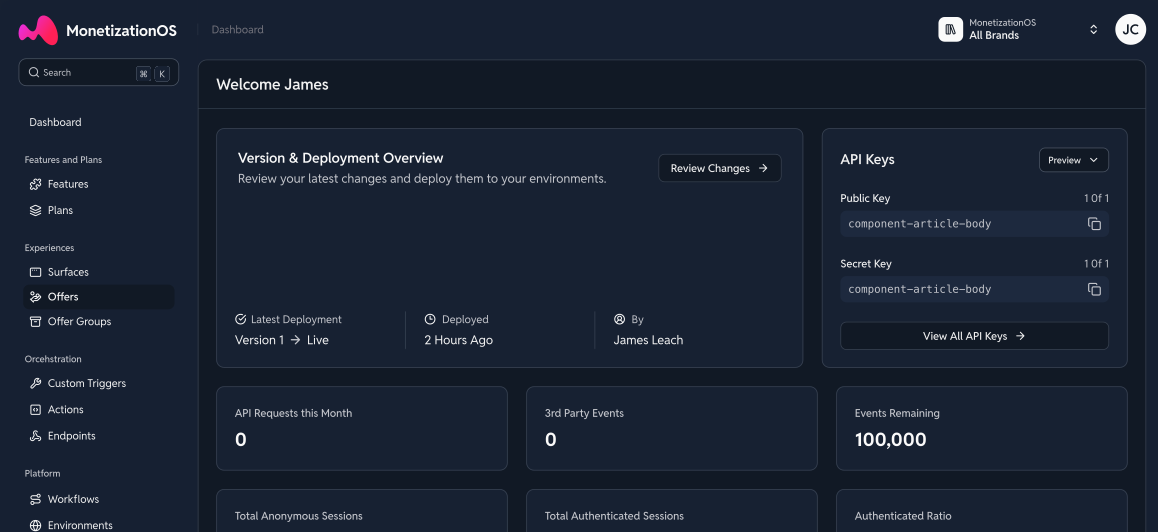
That constraint is solvable. A Monetization Operating System (MOS) sits between your learning experience and your commerce layer. It measures engagement and outcomes, manages identity and entitlements, and executes pricing logic - per milestone, per minute of tutoring, per verified assessment - without waiting for a monthly reconciliation. If the learner is stuck, access pauses and billing halts. If they pass the milestone, the charge fires, the instructor share clears, and the employer sees the record. Metered and outcome-based monetization becomes a control system, not a marketing promise.
<div anchor>Build for skill access</div>
Implications: build for skill access
If you lead a learning business, the shift is uncomfortable but tractable. It requires rethinking packaging, pricing, and systems.
- Replace courses with competency packs: Repackage catalogs into skill maps with milestones. Each pack defines expected time-to-proficiency, assessment criteria, and service levels (e.g., “responses within 2 hours,” “weekly human review”). This creates clear buyer expectations and units for pricing.
- Offer adaptive access tiers: Free for content browsing. Pay-per-milestone for individuals who want certainty without commitment. Subscriptions for teams that bundle a set of milestones with a defined service level. Enterprise contracts that set skill SLAs across roles and trigger payments on verified outcomes.
- Meter scarce services: Price human and compute-intensive elements - coaching minutes, AI tutor tokens, proctored exams—as metered services with caps and alerts. This protects margin and aligns price with the resources that actually drive progress.
- Build fairness into the contract: Guarantee progress. If a learner fails a milestone, auto-issue credits for additional support. If the platform misses its service level, pro-rate charges. Fairness keeps the relationship recurring because both sides can see and trust the exchange of value.
- Align internal incentives to outcomes: Shift instructor and content team compensation from activity (hours produced) to impact (milestones achieved, latency reduced). Reward the removal of decision distance: better routing, crisper feedback, earlier interventions.
- Give procurement observability: Enterprise buyers will increasingly demand proof. Provide dashboards that show skill attainment by cohort, time-to-proficiency trends, and spend-per-milestone. Seat licenses without observability will lose to contracts with clear skill SLAs.
MOS is the execution layer that makes this operable at scale. It connects the learning data (events, mastery estimates) to pricing and billing in real time. It enforces entitlements (who can access which services when), meters usage, and triggers charges or credits at the moment value is delivered - or not. The result is a market that pays for progress while protecting both learner and provider from one-sided risk.
The commercial impact is straightforward. Conversion improves because buyers face less risk and clearer value. Churn falls because fairness is visible in the product - payment stops when progress stops. ARPU grows through deeper skill stacks rather than superficial catalog bloat. Margins are protected because scarce resources are metered. And the relationship becomes self-perpetuating: learners stay because they progress; providers invest because they’re paid when they deliver.
The flood of free content isn’t going away. The winners in paid learning will compete where scarcity remains: attention, guidance, and accountable outcomes. Stop selling the library. Sell the path through it, priced to the steps that move people. If you can measure progress and monetize it fairly, you build a system that compounds. If you can’t, AI will eat your top line long before it touches your pedagogy.
-------------
MonetizationOS is edge-native infrastructure that governs and monetises every access request in real time, from human audiences to AI agents. It comes with 1,000,000 free operations per month, no setup fees, and deploys in hours. Get started for free at monetizationos.com