
TL;DR
- Most health apps charge for access during the hardest phase of habit formation, when effort is high and results are invisible. Users quit before the value compounds, and no amount of marketing fixes an economic mismatch.
- The root problem is outcome distance: too long a gap between action and felt result. Time-based subscriptions make users prepay through that valley, then churn before their internal cost-benefit tips in the product's favour.
- The fix is to price the milestone, not the calendar. Charge when users demonstrate progress rather than when hope begins, and pause billing when they stall. The exchange feels fair, so users stay longer.
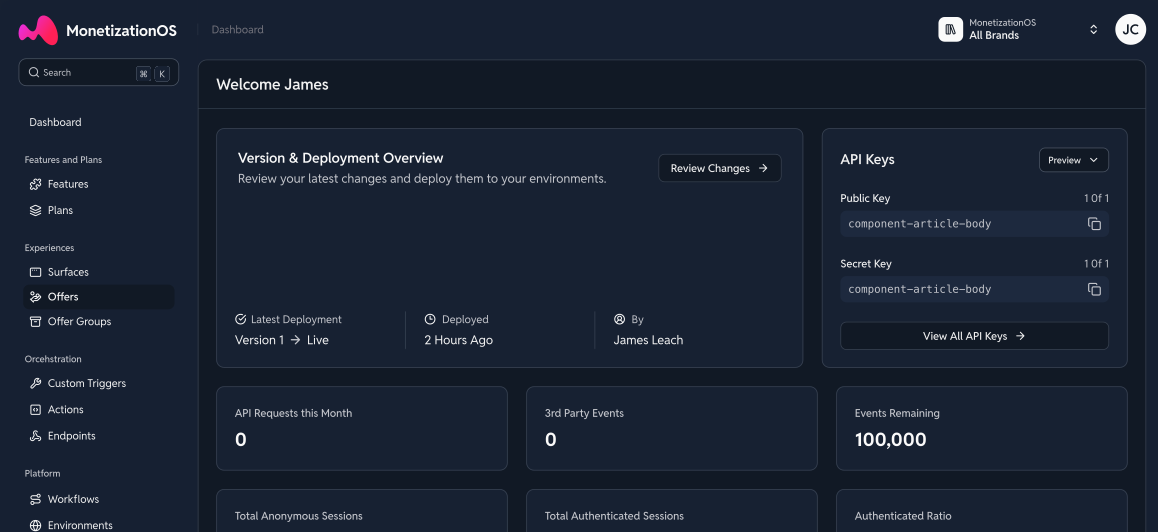
- A Monetization OS makes this operational: it meters streaks, completions and adherence in real time, issues feature entitlements when milestones are hit, and settles charges at the moment value is delivered.
- When price aligns with achieved outcomes, retention improves, waste falls, and LTV compounds. The product and the business model end up solving the same problem instead of working against each other.
Why Retention Is the Product in Health Apps
<div anchor>Introduction</div>
Most health apps sell time, then pray for habit. The result is predictable: users churn during the phase when effort is high and payoff is low, so value never compounds. Commonly cited industry data shows the majority of wellness users disappear within the first month. That isn’t a marketing problem. It’s an economic mismatch. We’ve priced the on-ramp like the highway.
The shift that matters: content is now cheap, motivation is scarce, and capital is demanding profit. AI has collapsed the cost of plans, prompts, and programs; anyone can generate a decent workout or meal plan. The differentiator is no longer what you say, but how well you convert initial intent into durable behavior. In a world where cheap capital is gone, you can’t buy your way through early churn. Retention isn’t a KPI; it’s the product.
<div anchor>Value Compounds After The Habit</div>
Diagnosis: value compounds after the habit, not before
Health outcomes are convex. Early efforts feel expensive - time, discomfort, cognitive load - while benefits are delayed and invisible. Only after repeated action does the curve bend: better sleep, weight change, resting heart rate shifts. Apps that charge by time (monthly subscriptions) ask users to prepay through the valley of low perceived value. Many quit before their internal cost-benefit flips.
Two distances make this worse:
- Decision distance: the gap between the user’s current state and the next action. Every new prompt is another decision tax.
- Outcome distance: the gap between the next action and a felt result. If it’s too long, motivation decays.
Most wellness products shorten decision distance (reminders, checklists) but don’t fix outcome distance. They still rely on time-based monetisation that extracts before proof. The economics degrade: high CAC to acquire intent-rich users, fast decay in Month 1, and a small surviving cohort bearing the whole LTV story.
Demand has also fragmented. Progress pace varies by user: novices, returners, athletes. Time-based pricing assumes homogeneity. It punishes slow starters (who need support most) and subsidises fast movers (who get outsized value per dollar). That perceived unfairness accelerates churn because people disengage when the exchange feels off.
<div anchor>Habit Formation Economics</div>
Mechanism: habit formation economics and the pricing misfit
Habit formation follows a loop - cue, routine, reward - but the reward needs to be salient enough, soon enough, to reinforce repetition. In practice:
- Early sessions require external scaffolding (nudges, friction removal).
- The identity shift (“I’m someone who…”) forms after consistent streaks.
- Social accountability and visible progress tighten the loop.
When the payment model is misaligned, it breaks the loop. A prepaid month is a sunk cost; once paid, there’s little marginal incentive to show up today. Conversely, a looming renewal is an aversive event - if I’m still not “feeling it,” I cancel to reduce future regret. Both effects weaken repetition.
There is a simpler logic: monetize where behavior locks in, not where hope begins. Price should sit on the milestone, not the calendar. Because behavior is the barrier, not access.
This is the fairness point in commercial terms. If the user advances, they pay more because they’re earning more value and are more likely to persist. If they stall, they pay less - or nothing - while you invest to help them cross the threshold. You trade some early revenue for a higher probability of compounding value and longer cash flows. Margin improves because waste - acquiring and billing non-adopters - declines.
<div anchor>MOS & Milestone Entitlements</div>
Mechanism: MOS and milestone-based entitlements
Implementing progress-linked pricing used to be hard. Storefronts, billing systems, and analytics were built around time and tiers, not micro-entitlements. A Monetisation OS (MOS) closes that gap by metering events in the product and turning them into dynamic rights and charges.
At minimum, MOS does four jobs:
- Meter progress: capture streaks, completions, biomarker submissions, adherence to a plan, or step-ups in difficulty.
- Define milestones: a configurable model of “meaningful progress” (e.g., complete Onramp 1: five sessions in seven days; sustain a 10-day streak; move from Beginner to Intermediate).
- Issue entitlements: unlock features, content, coaching slots, or community tiers when milestones are reached, across platforms and stores, within platform rules.
- Settle revenue: bill pay-per-progress (micro-charges per completed week) or milestone-based fees (a one-off unlock when a user clears Onramp), with clear proration and refund logic.
The commercial effect is twofold. First, you reduce perceived risk at sign-up. Users aren’t asked to bet a month’s fee while still in the motivational trough; they can start free or at a low meter, confident they pay when they progress. Second, you improve match quality between price and value. Fast progressors convert earlier and more deeply; slow progressors remain low-cost to serve until they’re ready.
Because AI is driving the marginal cost of content towards zero, the economic center shifts to orchestration - when to nudge, when to unlock, when to charge. MOS gives you the control surface to translate behavioral state into economic state in real time.
<div anchor>Design For Milestones</div>
Implications: design for milestones, price for outcomes
If retention is the product, build the product around milestones. Three practical steps:
1) Reframe activation as Onramp 1, not Day 1. Define a first behavioral milestone you can help a majority achieve within 7–14 days. Make it specific and empirically reachable: “Five guided sessions in seven days” beats “30-day challenge.” Gate meaningful features behind this milestone to focus attention; offer them as an entitlement the moment it’s hit.
2) Meter and charge with precision. Examples:
- Pay-per-progress: $1 per completed week on plan, capped at $X/month. If a week is missed, bill pauses automatically. Because the price maps to adherence, users feel the exchange is fair.
- Milestone unlocks: free until Onramp 1 is complete; then a one-time unlock fee enables Pro features for the next phase. You’re paid when the user demonstrates momentum.
- Outcome-aligned entitlements: sustain a 10-day streak and unlock a live class pass; maintain a recovery score above a threshold and access advanced programming. Avoid medical claims unless you have the evidence; stick to behavioral and usage milestones.
3) Move incentives into the product, not the promotion. The logic of discounting is right—reduce risk while the user is uncertain—but it usually runs in the wrong place (coupon codes, free months). Run it in the milestone model instead. Make the price a function of recent behavior so the best “offer” is earned by doing the work. That creates a virtuous loop: progress feels rewarded, so users repeat, so value compounds, so price becomes less sensitive.
Operationally, expect some friction:
- Analytics and finance need a shared definition of milestones. Avoid vanity metrics; use events that correlate with 60- and 90-day retention.
- Forecasting must evolve. Model LTV as a function of milestone conversion and cadence (e.g., LTV = Σ milestone probability × milestone price × expected repeats), not just “ARPU × months.”
- Platform constraints exist. You can implement metered or milestone pricing within app store policies, but details matter. MOS helps by abstracting entitlements and recording off-device progress so you can honor rights across channels.
The commercial upside is durable. Aligning price with achieved outcomes increases survival curves, which compounds gross margin contribution. It also broadens your addressable market. Progress-based pricing lowers entry barriers for cautious users while letting committed users pay more, fairly, over time. In a post-cheap-capital world, that reduces CAC payback risk and stabilizes cash flows.
<div anchor>The Takeaway</div>
The grounded takeaway
You don’t need better content. You need better economics of behavior. Price the on-ramp as an investment you share with the user, and collect where evidence of habit appears. Use MOS to meter progress and issue entitlements at the right moments. When the exchange feels fair and the charge lands on achievement, retention improves—because the product and the business model are finally solving the same problem.
-------------
MonetizationOS is edge-native infrastructure that governs and monetises every access request in real time, from human audiences to AI agents. It comes with 1,000,000 free operations per month, no setup fees, and deploys in hours. Get started for free at monetizationos.com