Count the offers on your site.
For most subscription businesses it’s either a handful that haven’t moved in years, or hundreds of legacy offers nobody wants to touch. Either way, it usually has more to do with what’s been easy to build than with what customers want. Every new offer, and every change to an old one, costs time and people, so only the big ideas get built and the rest sit on a list that gets longer.
One team we spoke to plans its tests three months in advance and then waits another three months for the data. By the time they know what worked, half the year has gone.
Now picture the same business with a thousand offers.
A pass for fans of one team. A rate for lapsed subscribers in one town. A license for an AI company that wants the archive. A detailed brief for an agent helping someone buy a house.
Each one is for somebody the standard offer never reached.
Publishers have wanted to build offers like these for years, but often the time and engineering involved made them hard to justify.
How the same product gets split up
Start with your catalog, broken into parts: news, recipes, puzzles, live sports, travel, audio, the archive, each with a price.
Then let each visitor be offered a different mix of it, within guardrails you’ve set. It might look like this.
- A subscriber on the app who visits 17 times a month and cooks on Saturdays gets Weekend Kitchen: recipes, video and puzzles, ad-free, $7.99 a month, pause anytime.
- A household with three devices and Saturday sports gets Game Day Family: live games, game recaps, four seats and the weekend print edition, $15.99 a month.
- A customer who mostly arrives through an AI assistant gets Commute Brief: the morning briefing and audio, up to ten articles a day, $4.99 a month.
- An agent on a single task, with a declared purpose, gets a Research Pass: twelve rights-cleared travel guides at $0.35 an article, paid per use.
Your catalog and prices stay the same. What changes is how much of it each person gets, and the guardrails decide how far each offer can bend.
A thousand offers would overwhelm most people, which is where AI assistants will come in. Sorting through a catalog in seconds is exactly what they’re good at.
So how does the right offer get picked?
Well, here’s one way it could work.
The publisher’s side offers the package that fits best and, if the answer is no, suggests a smaller one, down to the smallest offer the business is willing to make.
The reader’s side never has to show its budget, it just says yes or no. And because it’s the package that changes, each one costs the same for everyone.
As AI assistants get better at spotting discounts, it will get harder to charge different people different prices for the same subscription. A smaller package at its own price gives publishers another way to win people over without discounting the full subscription.
The obvious risk is full-price subscribers trading down, so the smaller packages are best kept for people who weren’t going to buy the full one anyway, and testing helps you work out who they are.
What happens when an offer costs almost nothing to build
In 1840, Rowland Hill had a version of this problem with the post. Postage was priced by distance, but Hill worked out that the real cost was the handling, so he made a letter anywhere in Britain cost a penny. Within a year the number of letters had more than doubled.
Millions of letters that had never been worth sending suddenly were.
AI is starting to do the same thing to offers. When building one takes minutes, the offers that were never worth a team’s time suddenly are. Teams can experiment more easily, and the list stops getting longer.
A thousand offers only work if someone can manage them, and that’s already possible.
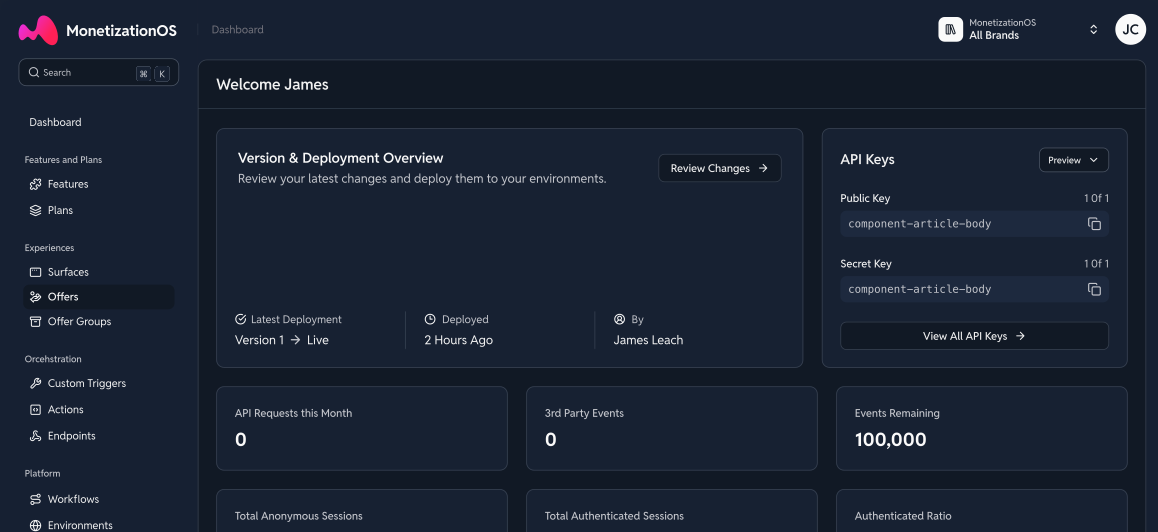
MonetizationOS is built so a commercial team can create, change and keep track of offers without each one becoming its own project. With the MonetizationOS MCP, your team can describe a new offer in the AI tool they already use, and MonetizationOS builds it inside the rules you’ve set.
That’s one part of agentic monetization, and the part you can use today. Choosing which offer each customer sees is what comes next, and it’s worth having the product and the rules ready before it does.
MonetizationOS is the layer that decides who gets access to what, for every visitor, human or machine, along with the offers and rules behind those decisions. If you’d like to talk through what a wider set of offers could look like for your business, schedule a call with our Head of Global Revenue, Scott Howland.