.jpeg)
Most monetization tools are chosen by the people who'll use them and paid for by someone who won't.
I'm a CFO, so I've seen this from both sides: signing off the spend on our own stack, and sitting across from a buyer's finance team as the vendor whose numbers they're picking apart. It's the same handful of things that decide it, wherever you're sitting.
At some point - usually a renewal, sometimes a migration - your finance team gets involved, and the questions change. They're about money, risk and what you're tied to. Come with the answers ready and you keep control of the conversation and the budget. Without them, the project stalls while you go and find them.
Here are the five questions I'd want answered if I were signing off your stack.
1. What's the total cost of ownership - not the license fee?
The number on the contract is the smallest part.
Add the implementation cost, the internal hours to maintain it, the integrations you pay for to make it work with everything else, and the consultants you brought in because the documentation wasn't enough.
If you can't total that up clearly, your CFO will assume the real number is higher than you think - and they'll usually be right.
2. How much leverage do you keep at renewal?
Every vendor builds in switching costs, and finance reads them as the answer to a different question: how much negotiating power do you actually have when the contract's up?
The explicit ones are easy to spot: exit fees, data export charges. It's the hidden ones that hurt - the engineering hours to rebuild integrations, the subscriber churn from forced re-authentication, the revenue lost mid-transition. The higher those are, the less you can push back on price, terms or a roadmap you don't like, because the vendor knows leaving hurts more than staying.
If you can't credibly walk away, you'll keep overpaying to stay.
3. Where does revenue recognition actually happen?
For a subscription business this matters more than most teams expect.
Where does the billing data live? Can finance pull what it needs for reporting without an engineering request? Does the system support the deferrals and allocations your auditors require? If the honest answer is "we export to a spreadsheet and fix it by hand," expect follow-up questions - and have a better answer than that one.
4. Does this consolidate the stack, or add to it?
Finance counts tools, because every extra system is another contract to renew, another integration to keep alive, and one more thing that can break.
Replacing three tools with one is an easy business case. Adding a fourth that just sits alongside the rest is a much harder sell. Be clear which you're proposing - and if you're adding, say what comes out to make room.
5. Who actually owns the subscriber data and the logic?
This is the question that decides how free you really are - and the one that matters most if the vendor is ever acquired.
Can you export every subscriber record, payment history and entitlement whenever you want, in a format you control? Does your subscription logic live in a system you can leave, or inside a vendor you'd have to recreate from scratch? An acquisition, a price hike or a roadmap you don't like are all survivable if the data and the logic are yours to take.
When they're not, you don't have a vendor relationship - you have a dependency, and your CFO will price it as one.
Why this is really an architecture question
Run those five questions across your stack and a pattern shows up.
Cost, lock-in, reporting friction and consolidation almost always cluster in the same place: the tools where business logic is trapped inside someone else's system and can't easily be moved or changed.
That's the case for separating the layer where you decide things - who gets access, at what price, on what terms - from the systems that merely execute them.
When the decision logic is yours, configurable and portable, your CFO's five questions get easier answers: lower total cost because there are fewer tools and fewer engineering tickets for every price or packaging change, more leverage because the logic isn't held hostage, and no single vendor that can freeze your roadmap.
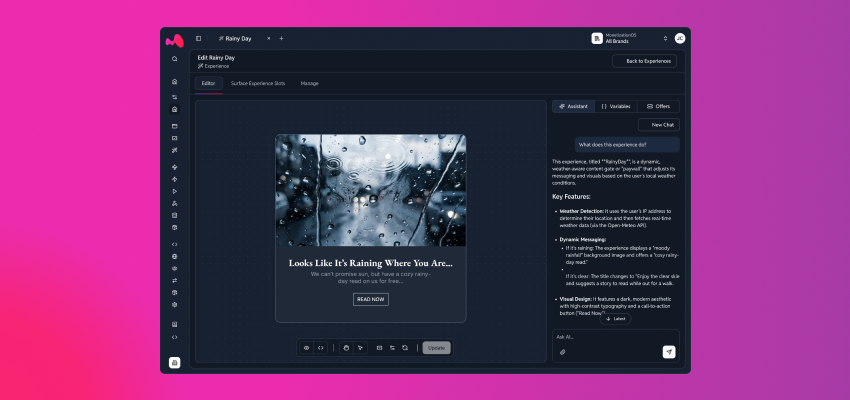
That's the thinking behind how we built MonetizationOS - the access and entitlement decisions kept in your control, above the billing and identity tools rather than locked inside them.